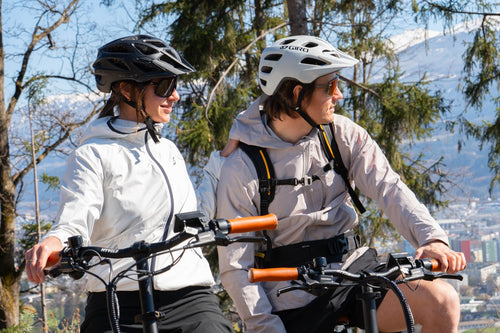
The mobility of tomorrow is sustainable, flexible, and environmentally friendly. While cars still dominate the roads and cause a significant portion of CO₂ emissions, e-bikes are increasingly gaining importance as a practical alternative.
By Fabian Huber 4 minutes read time


Published: March 15, 2026 | Updated: March 17, 2026
Things get especially interesting when e-bikes are combined with solar power – a way to travel emission-free, cost-effectively, and independently. In this guide, we show you how you can use your e-bike and clean energy to commute in an environmentally friendly way, travel for leisure, and actively contribute to the energy transition .
The transport sector is one of the biggest drivers of greenhouse gases. According to current studies, road traffic, primarily passenger cars, accounts for around 20–25% of CO₂ emissions in Germany . Those who regularly forgo using a car and opt for e-bikes instead can not only significantly improve their own carbon footprint, but also benefit from time savings, flexibility , and a healthier lifestyle.
E-bikes make it possible to effortlessly cover medium distances of up to 130 km without physical fitness being a barrier. This makes them particularly attractive for commuters who travel 20–60 km daily, but also for recreational cyclists planning longer tours. Average speeds of 20–25 km/h ensure a good balance between range, comfort, and energy consumption.
E-bikes score points with their increased range , which is extended compared to regular bicycles thanks to the electric motor. Most modern models achieve 80–130 km per battery charge , depending on the terrain, weight, weather conditions, and riding style. An average speed of 20–25 km/h is ideal for efficient energy use while maintaining a comfortable riding experience.
Another advantage: E-bikes consume only a fraction of the energy that a car needs for the same distance. While a small car consumes around 6–7 liters of gasoline per 100 km, an e-bike gets by with about 0.5–1 kWh of electricity per 100 km – that corresponds to only a small fraction of the CO₂ emissions .
This makes e-bikes a key component of sustainable mobility , especially when the electricity comes from renewable sources such as solar energy .
The most exciting aspect of sustainable mobility is the combination of e-bikes and solar power . This allows you not only to ride emission-free, but also to save costs in the long term and become independent of fossil fuels.
Solar power is generated via photovoltaic modules – whether on the roof, balcony, or as a mobile solution. The generated electricity can then be used to directly charge the e-bike battery. Many e-bikes have lithium-ion batteries with a capacity of 400–700 Wh , which is perfectly adequate for a realistic range of 80–130 km .
Permanently installed at home: A solar panel on the roof feeds the electricity directly into the house grid or into a wallbox for the e-bike battery.
Balcony solution: Compact solar panels are ideal for apartment owners on their balconies. With a power output of 300–500 W, several charging cycles per week can be covered.
Portable solar panels: Ideal for outdoor enthusiasts who go on longer trips. Small, foldable solar panels can recharge batteries on the go.
A typical 500 Wh e-bike battery only needs 0.5 kWh of electricity to fully charge. An average solar power system on a single-family home generates 3–5 kWh per day , which is easily enough for several battery charges.
If the battery is charged exclusively with solar power, no direct CO₂ emissions are produced. For comparison: diesel or gasoline for the same distance generates 15–20 kg of CO₂. Over the course of a year, a regular e-bike commuter saves several tons of CO₂ , depending on their mileage.
Recharge batteries when they are at a medium charge level to maximize their lifespan.
Coordinate charging times with hours of sunshine to achieve maximum efficiency.
Feed excess electricity from the solar system into the house grid when the battery is full.

To ensure that the e-bike powered by solar energy actually works in everyday life, a structured approach is worthwhile.
Plan your commutes to be between 20 and 60 km per day. E-bikes with a range of 80–130 km can easily cover this.
Combine your routes with public transport in case your battery runs out.
Prefer partial charges: Lithium-ion batteries benefit from frequent, short charges rather than infrequent full cycles.
Pay attention to the temperature: Batteries are best charged between 15–25 °C.
Moderate speed: 20–25 km/h is ideal to maximize the range.
Light luggage: Weight directly affects energy consumption and battery performance.
Check tire pressure: Optimally inflated tires reduce rolling resistance.
Mobile solar panels or solar backpacks for small charging cycles on the go.
Bicycle app for route suggestions: Shows charging stations or shaded parking spots.
Weather-dependent planning: Heavily cloudy days may require longer charging times.
Not only e-bikes, but also other sustainable mobility solutions benefit from solar energy:
Cargo bikes / cargo e-bikes: Ideal for families or transport, range similar to normal e-bikes.
Bike sharing with solar charging stations: Many cities are now testing public solar charging points for e-bikes.
Combination with Smart City technologies: solar charging points at workplaces or public places.
E-bikes combined with solar power are a practical, cost-effective, and environmentally friendly solution for reducing your carbon footprint. Whether for commuters, weekenders, or leisure cyclists – with ranges of 80–130 km and speeds of 20–25 km/h, everyday life can be easily managed.
The future of mobility is emission-free, flexible, and solar-powered . Every kilometer traveled using solar energy contributes to the energy transition. Those who choose e-bikes today are not only driving smartly, but are actively at the forefront of a sustainable mobility revolution .
Enter your daily route and see how much CO₂ you emit with different modes of transport.
CO₂ emission comparison
| Transport mode | CO₂ per trip (kg) | CO₂ per week · 5 days (kg) | CO₂ per year · 52 weeks (kg) |
|---|---|---|---|
| Car (petrol) | – | – | – |
| Public transport | – | – | – |
| E-Bike (grid electricity) | – | – | – |
| E-Bike (solar power) | – | – | – |
| Regular bike | – | – | – |
Guideline values. Actual CO₂ emissions depend on driving style, vehicle type and electricity source.