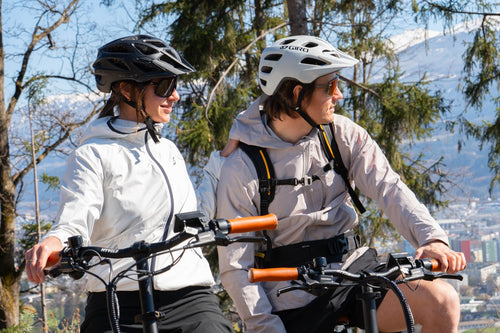
The so-called "last mile" describes the final leg of a journey, which one often has to travel to reach one's actual destination. Classic examples are the route from the train station to the workplace or from the parking lot on the outskirts of town to the city center.
By Helena Burgardt 5 minutes read time


Published: May 15, 2026
The problem: This section is often too short to be driven efficiently by car, yet too long to be comfortably walked. This creates a mobility gap that cannot be satisfactorily closed by either traditional public transport or private vehicles.
This is precisely where smart mobility solutions come into play – and the e-bike is increasingly proving to be one of the most effective keys to overcoming the “last mile” comfortably, sustainably and quickly.
The importance of the "last mile" is constantly increasing – and for several reasons:
Urbanization : More and more people live in cities where space and parking are scarce.
Traffic congestion : Traffic jams in city centers cost time, nerves and money.
Environmental goals : Climate protection measures demand alternative, low-emission transport concepts.
Flexible working environments : Home office, co-working spaces and hybrid working models create new mobility needs.
The e-bike hits the mark here: It is flexible, low-emission and can be used both as an independent means of transport and in combination with bus, train or car.
E-bikes are no longer just a trend. They have become an integral part of modern mobility concepts. Especially in cities, they are unbeatable when it comes to the "last mile".
🚉 Seamless connection to public transport : A folding e-bike fits easily into the train and allows for a stress-free onward journey.
🕒 Time saving : Instead of waiting for the connecting bus, you can simply drive straight away.
🌱 Sustainability : Every kilometer traveled by e-bike reduces CO₂ emissions compared to a car.
💪 Health benefits : Despite motor assistance, movement is not eliminated – the cardiovascular system and muscles benefit .
💸 Cost efficiency : E-bikes are cheaper to maintain than cars , and parking fees are often completely eliminated.
Not everyone needs their own e-bike – sharing services are ideal, especially for the “last mile”.
Many major cities now have e-bike rental systems that can be easily booked via app. You hop on at the train station, ride the last leg to your office, and leave the bike there. This flexible approach makes everyday life less stressful and simultaneously reduces car traffic on the roads.
Some advantages of sharing models:
No acquisition costs
No maintenance or repairs necessary.
Use only when needed
Wide availability in urban areas
However, sharing services are also dependent on availability – especially during peak hours, there may not be a bike nearby. Those who commute regularly therefore often prefer to use their own e-bike .
The "last mile" affects not only commuters but also delivery logistics . The industry faces massive challenges, especially in cities: increasing parcel volumes, narrow streets, and environmental regulations.
This is where e-cargo bikes come into play. Large logistics companies like DHL, Hermes, and Deutsche Post have long relied on cargo e-bikes to deliver packages emission-free and without traffic jams directly to the customer's doorstep.
🚚 Efficiency : E-cargo bikes can often navigate through narrow streets or pedestrian zones faster.
🌍 Environmentally friendly : CO₂-neutral delivery is a strong selling point.
📦 Cost reduction : Lower fuel and parking costs.
🏙️ Suitable for city centers : Access restrictions do not apply to e-bikes.
Especially during the e-commerce boom, the "last mile" is becoming the biggest logistical challenge. E-bikes are an important piece of the puzzle.
Not every e-bike is equally suitable. It strongly depends on the route, personal needs, and the combination with other means of transport.
It can be folded and easily taken on the train.
Perfect for commuters who combine train and bicycle travel.
Weight often under 20 kg
Comfortable, with an upright seating position
Ideal for daily short trips in city traffic
Often equipped with practical extras such as luggage racks or baskets
For transport or shopping
Especially suitable for families or small businesses
Increasingly popular for delivery services
Although not strictly speaking e-bikes, e-scooters and compact e-mopeds also play a role in the "last mile". They are space-saving, fast and flexible – however, they do not offer a comparable health benefit.
To ensure that the "last mile" runs smoothly in everyday life, here are a few concrete tips:
Planning your commute : If you use bus and train, you should make sure that your e-bike is easy to transport (ideally a folding model).
Pay attention to battery life : Even if the journeys are short, a dead battery is annoying . Charge it in time!
Check parking and storage options : A sturdy lock and a secure parking space are mandatory.
Use multimodal apps : Platforms like Jelbi, Moovit or Nextbike combine public transport and micromobility in one app.
Comparing commuting costs : In many cases, an e-bike subscription or purchase saves significantly compared to parking or public transport season tickets.
The increasing use of e-bikes is changing not only individual mobility, but also urban planning:
Less car traffic : Relief for city centers.
Improved quality of life : Less noise, better air.
New infrastructure : Expansion of cycle paths and charging points.
Sustainable cities : E-bikes are a building block of "Smart City" concepts.
This makes the "last mile" a central aspect of modern urban development – and e-bikes are a catalyst for this transformation.
The importance of the "last mile" will continue to grow. With the progress of electrification and digitalization , the following developments could become reality in the coming years:
Integrated mobility platforms : One ticket for all modes of transport, including e-bikes.
Autonomous micro-depots : a combination of drones, e-cargo bikes and public transport.
Even lighter and smarter e-bikes : Thanks to new battery technologies and IoT connectivity.
Political support : Subsidies for commuters and companies that rely on e-bikes.
E-bikes not only make the "last mile" faster, but also more sustainable and healthier. They are the link between public transport , logistics and individual mobility – and thus a key factor in the transport revolution.
Whether as a commuter on the way to work, as a company with a sustainable delivery strategy, or simply as a city dweller who wants to be independent on the go: E-bikes are the answer to the challenges of the "last mile".
🎁 You've found your commuter type! Get €50 off now with the code:
*Valid from a minimum order value of €1,000