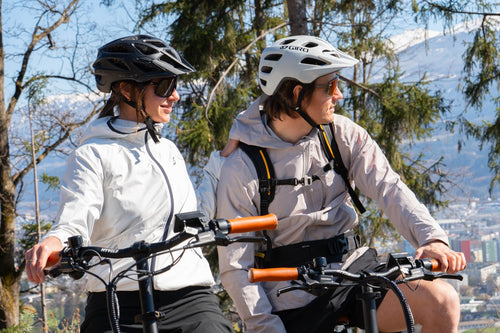
Himalaya E-MTB
incl. FREE shipping & free returns
📣 Only for a short time 200€ savings
📦 Delivery end of August
Have you ever heard terms like Pedelec, S-Pedelec and E-Bike without being able to identify the exact differences?
By Fabian Huber 3 minutes read time
Fabian founded MYVELO together with Vincent. The two share a long-standing passion for cycling. Together they have cycled thousands of kilometers and fought for victories in the German racing bike league. The idea of founding MYVELO arose from their many years of experience and knowledge of what makes a good bike. Find out more about MYVELO now
Published: April 8, 2021 | Updated: June 9, 2025
There are many terms in circulation around the topic of electric bikes, and there is a lot of confusion. Today we will focus on the terminology in order to clear up any misunderstandings and to provide a good overview for anyone interested in e-bikes.
First of all, it is important to find out what the term Pedelec means - it is simply an abbreviation for Pedal Electric Cycle. Here, the rider is supported with a maximum motor output of 250 watts up to 25 km/h. If you want to go faster, you have to use your own muscle power. The support can be regulated in several stages depending on your own muscle power and cadence, so that everyone can find the right level of support.
The definition of a Pedelec comes from the Road Traffic Act. Legally, it is absolutely the same as a normal bicycle. You don't need a driver's license, registration or insurance number. Furthermore, you don't need a helmet when riding - at least legally - and there is no age limit. This also applies if the Pedelec has a starting aid up to 6 km/h. Choose - buy - drive off - have fun (in our online shop you will find various models in the E-Bike folding bike category).
Pedelecs make up about 90% of the entire electric bicycle market.
Legal information can be found here
An S-Pedelec is no longer a bicycle, but a small motorcycle. It works the same as a normal Pedelec, but you are supported up to a speed of 45 km/h , with a (current) maximum Motor power of 4000 watts.
To be allowed to ride such a fast Pedelec, you need a class AM driving license, you must be at least 16 years old and you must also wear a "suitable" safety helmet. There is currently no precise definition of what constitutes a suitable safety helmet. However, there are now a number of helmet manufacturers who advertise helmets that meet motorcycle standards. These are light and well ventilated and are therefore ideal for cycling.
Big disadvantage: S-Pedelecs are not allowed on cycle paths, even if they are approved for mopeds.
For the S-Pedelecs, the manufacturer requires an operating license or individual approval from the Federal Motor Transport Authority (KBA). You as the owner, holder or driver require an insurance license plate - the cost is around €70 per year - and can be obtained from any standard insurance company.
All good things come in threes - which brings us to our last category. This is the electric light moped. The bike can be driven using a twist grip or gear knob without pedaling - just sit on it and drive off. The e-bike (electric light moped) must not have a motor output of more than 500 watts and can only support up to 20 km/h. If you want to go faster than 20 km/h, you are again dependent on your own muscle power.
As already reported for the S-Pedelec, we also need an operating license, a moped test certificate and an insurance number for the e-bike . However, there is no obligation to wear a helmet on e-bikes. In addition, they do not currently play a major role on the market. However, there is an upward trend among young people - the moped of today!
As a final remark, it should be said that the electric bike market now has something suitable for everyone who wants to get around on two wheels. You can find our current selection right here in the shop.
The team at MYVELO – your e-bike platform – wishes you lots of fun on the roads and safe journeys at all times.
Get advice from cycling enthusiasts
A pedelec (pedal electric cycle) is an electric bicycle where the electric motor only assists the rider when they pedal. The motor's power is limited to 250 watts, and the electric assistance cuts out at 25 km/h. If you go faster, you have to maintain that speed using your own power – the motor then switches off.
Unlike a classic e-bike, where you can ride without pedaling using a throttle or thumb throttle, a pedelec is closer to a traditional bicycle. Therefore, it is legally classified like a normal bicycle: you don't need a driver's license or license plate, and you can use bike paths. Wearing a helmet is not legally required, but it is recommended – especially at higher speeds downhill or in traffic.
Pedelecs are particularly well-suited for everyday riders, commuters, or older people who want to stay active but would like occasional assistance – for example, when starting on inclines or against a headwind. They are also ideal for people who want to expand their mobility without sacrificing environmental friendliness or exercise.
The range of modern e-bikes is also impressive: Depending on the model, terrain, and assistance level, a single battery charge can cover between 40 and 120 kilometers. The riding experience remains very natural, as the motor assistance responds dynamically to the rider's pedaling effort.
In short: The e-bike combines the advantages of cycling with electric assistance – without bureaucracy and with maximum riding enjoyment.
An e-scooter is an extremely practical means of transportation, especially in cities. These small, electrically powered scooters are designed for quick and easy short trips – for example, from the train station to the office, from university to the supermarket, or simply the last mile home.
E-scooters can be easily rented via app or purchased as your own vehicle. In Germany, an insurance sticker is required for use on public roads, but a driver's license is not necessary as long as you are at least 14 years old. The speed is limited to 20 km/h, and they may only be ridden on bike paths or roads – not on sidewalks.
The major advantage: E-scooters are lightweight, maneuverable, and space-saving. They can be folded up, taken on public transport, or stored in the office. Ideal for commuters, city dwellers, and anyone who wants to get around quickly and flexibly – without the hassle of finding parking or dealing with traffic jams. They are also practical in combination with other modes of transport: for example, from home to the train station, or from the station to the office.
However, e-scooters also have limitations. Their range is usually between 20 and 40 kilometers, depending on riding style, battery, and terrain. They are less suitable for longer distances or steep inclines. Furthermore, caution is advised in rain or snow – the small tires offer limited traction in these conditions.
Overall, the e-scooter is a smart addition to the transportation mix. Especially in cities with parking problems and heavy traffic, it offers a fast, climate-friendly alternative – for everyone who wants to travel independently and flexibly.
An S-Pedelec (Speed Pedelec) is a fast electric bicycle that looks almost identical to a regular pedelec but has significantly more power. The electric motor assists pedaling up to 45 km/h (25 mph) – meaning that, legally, the S-Pedelec is no longer classified as a "bicycle" but as a light motorcycle.
This has important consequences: Riding an S-Pedelec requires a Class AM driver's license, which can be obtained from the age of 16. The vehicle must also be insured, identifiable by the insurance license plate on the rear fender. A properly certified helmet (according to ECE standards) is also mandatory – a regular bicycle helmet is not sufficient.
Another point: S-Pedelecs are not allowed on bike paths – even if there is a "Mopeds Allowed" sign. Therefore, they must be ridden on the road, which requires a certain level of road safety knowledge and experience.
Despite these limitations, S-Pedelecs offer significant advantages – especially for commuters who want to cover longer distances quickly and efficiently. For distances up to 30 kilometers, the S-Pedelec can easily keep pace with a car – with lower operating costs, fewer emissions, and often without traffic jams.
Thanks to modern batteries, ranges of 60 to 100 kilometers are also possible. Particularly in rural areas or regions with a well-developed road network, the S-Pedelec can be a genuine alternative to a second car.
In conclusion: For those who want to travel quickly and electrically and have no issues with a driver's license and insurance, the S-Pedelec offers a powerful and sustainable mobility solution.
Exclusive for subscribers: Get exclusive insights, pro tips and offers that nobody else gets. Sign up and save on MYVELO Gear!
Added to your cart: