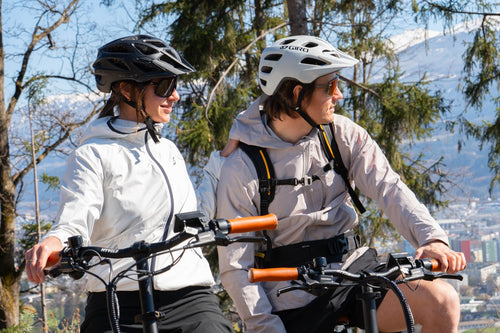
Cycle as much as possible for three weeks – and not only rack up your own kilometers, but also save CO₂, influence local politics, and be part of one of Germany's largest cycling campaigns. That's the idea behind City Cycling . Whether you're a casual cyclist or a daily commuter, whether you ride a city bike or an e-bike – City Cycling makes every kilometer countable.
By Vincent Augustin 5 minutes read time


Published: May 21, 2026 | Updated: May 21, 2026
City Cycling is an international competition for municipalities, businesses, schools, and clubs – coordinated by the Climate Alliance , a European network of cities and towns. The concept is simple: teams of at least two people cycle as many kilometers as possible over 21 days . Each municipality sets its own campaign period – usually between May and September.
The special thing about it: You don't have to be a competitive athlete. It's specifically about everyday mileage – trips to work, to the supermarket, to school, to friends. Every trip counts that you would otherwise have made by car.
City Cycling is not a small initiative. In recent years, the campaign has developed into one of the most important cycling projects in German-speaking countries.
| Year | Participating municipalities (D) | Active cyclists | Kilometers accumulated |
|---|---|---|---|
| 2018 | 614 | 300,000 | 48 million km |
| 2021 | 1,841 | 730,000 | 142 million km |
| 2023 | 2,800+ | over 1 million | 244 million km |
| 2024 | over 3,000 | over 1.3 million | 285 million km |
244 million kilometers – that's roughly three times the distance between the Earth and the Sun. Since 2008, over one billion kilometers have been cycled in Germany alone.
On the official website stadtradeln.de you can search to see if your city or town is participating – and if so, when their campaign period is. More and more municipalities are taking part, including major cities like Munich, Hamburg, and Cologne, as well as small rural communities.
You can join an existing team – your employer's team, your club's team, your school's team – or create your own. A team needs at least two people. Individuals can also participate via an open "everyone's team".
During the 21-day campaign period, you enter your cycling kilometers daily – either manually at stadtradeln.de or via the Stadtradeln app , which automatically records and analyzes your rides. The app recognizes whether you are actually cycling and not, for example, sitting in a car.
At the end of the campaign period, the kilometers cycled will be analyzed. Your municipality will receive a detailed picture of when and where its citizens cycle – valuable data for local transport planning.
Every kilometer you cycle instead of driving avoids CO₂ emissions. The City Cycling campaign calculates an average of approximately 130 g CO₂ per kilometer (based on the German average for passenger cars).
For example: If you cycle 5 km to and from work every day for three weeks instead of driving – that's 210 km – you'll avoid around 27 kg of CO₂ . That may not sound like much, but: 1.3 million people doing this would result in 35 million tons of emissions saved – in just three weeks.
Remember: The City Cycling Challenge isn't just about who cycles the most. The total distances cycled are presented to local politicians as an argument for better cycling infrastructure. By participating, you're also voting for more cycle paths.
One of the most important functions of the City Cycling campaign is often invisible: communication with local politicians . Municipalities participating in the City Cycling campaign commit to incorporating the results into their transport planning. The collected GPS data shows which routes are frequently used – and where it is dangerous or difficult.
In addition, many municipalities are using the campaign as an opportunity to publicly discuss local cycling policy. Many cities are hosting accompanying events, panel discussions, and public rides with city council members. The message behind this: cycling is not a niche project – it reflects the will of the majority.
Studies show that municipalities that have participated in city cycling multiple times have invested measurably more often in cycling infrastructure than those that do not participate.
E-bikes are explicitly permitted in the city cycling campaign – and they count just like any other kilometer. In fact, analyses show that e-bike riders cover longer distances on average than cyclists without assistance.
This makes sense: The pedal assist makes routes possible that would be too strenuous without a motor – such as the longer route over the mountain, or the trip to the supermarket with heavy shopping. For commuters in particular, the e-bike is therefore a real ace for urban cycling: Someone who commutes 15 or 20 km daily instead of 5 will accumulate over 600 kilometers in 21 days.
Plan alternative routes. Many routes can be lengthened with a small detour – a side trip through the park, the route via the market square. You'll still reach your destination, but with more kilometers on the odometer.
Combine your routes. Run errands by bike that you would otherwise do by car: bakery, pharmacy, visiting friends. Every one of them counts.
Motivate those around you. An active team achieves more than you alone. Friends, family, colleagues – everyone who participates increases the fun and the kilometers covered.
Use the app. The City Cycling app makes registration much easier. It records automatically, and you don't have to log in every day.
Read the route map. Many municipalities publish a map showing frequently used or reported problem areas. This shows where political action is needed.
More and more companies are forming their own city cycling teams – not only for environmental reasons, but also because the campaign is a powerful tool for workplace health management . Regular cycling reduces sick days, increases concentration, and improves the working atmosphere.
Employers who actively invite their employees to participate can also use the results for their sustainability reports. Furthermore, providing employees with bicycles or e-bikes – for example, through a company bike leasing program – significantly increases participation.
Do leisure trips count too, not just everyday journeys?
Yes. All cycling kilometers count, whether it's for shopping, commuting to work, or a Sunday ride. The only important thing is that you cycle them during your municipality's official campaign period.
What if my community isn't participating yet?
You can actively encourage your community to participate – through council members, local associations or simply via the official City Cycling website, which offers a contact function for municipalities.
Can I participate in a different city than the one where I live?
Yes. You can join the city where you work, go to school, or any other city you wish to participate in.
Are the GPS data used by the app compliant with data protection regulations?
The City Cycling app only records location data during active tracking and stores it on servers in Germany. The Climate Alliance's privacy policy complies with the GDPR.
City Cycling is one of the few campaigns where you can simultaneously exercise, reduce CO₂ emissions, participate in political decision-making, and connect with other people. The effort required is minimal – all you need is your bicycle and a little motivation. However, the impact can extend far beyond the 21 days: better cycle paths are created where many kilometers are cycled and cities find the courage to redistribute road space.
So: Check if your local council is participating, find a team - and off you go.