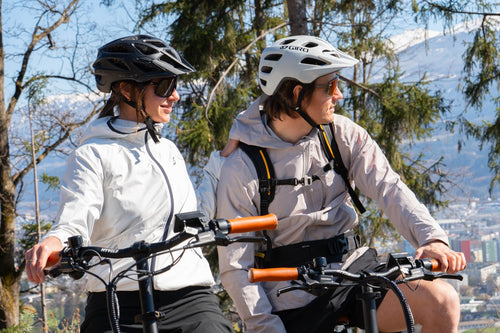
Do you dream of cycling through the flat polders of the Netherlands, crossing Copenhagen's bicycle bridges, or exploring the Australian coast on your e-bike? Then you should know beforehand: cycling isn't the same everywhere. Every country has its own infrastructure, its own laws – and sometimes even its own unique cycling culture. In this article, we'll take you on a tour around the globe and show you what to expect – including the most important rules for e-bikes and pedelecs.
By Fabian Huber 6 minutes read time


Published: June 15, 2026
Anyone talking about cycling infrastructure can't ignore the Netherlands. With over 37,000 kilometers of physically separated cycle paths – which corresponds to about a quarter of the entire road network – the country is unchallenged number one worldwide. For 17.8 million inhabitants, there are approximately 23 million bicycles , that's more bicycles than people.
The result of these investments is impressive: 27% of all journeys In the Netherlands, a significant portion of commutes are made by bicycle, with cities like Amsterdam and Utrecht accounting for over 38%. According to a recent analysis, the number of commuters cycling to work increased by a substantial amount between March 2024 and 2025. 57% .
A normal one e-bike (Up to 250 W, assistance up to 25 km/h) is legally considered a bicycle in the Netherlands. This means: no driver's license, no insurance requirement, no helmet required – and full use of cycle paths.
S-Pedelecs (Up to 45 km/h) have been classified as mopeds ( bromfiets ) since 2017. The following rules apply to them: minimum age 16, AM driving license, vehicle insurance, yellow moped license plate, and helmet requirement. S-Pedelec riders are generally allowed on cycle paths. not to use.
Attention 2026: The Dutch police are now using mobile test benches ( rollerbenches ) to test e-bikes directly at the roadside to determine their actual assisted speed. Anyone riding a manipulated e-bike faces immediate fines and confiscation of the vehicle.
Denmark – and especially Copenhagen – is considered a living experiment in how consistent cycling can transform a city. Wide, clearly marked cycle lanes, dedicated traffic light phases for cyclists, and spectacular cycle bridges like the Cycles snakes have led to more than 62% of Copenhageners Using a bicycle daily - regardless of the weather.
Especially interesting for e-bike fans: In Denmark, they are allowed S-Pedelecs are allowed on many cycle paths , which has led to a significant boom in high-speed e-bikes. This more liberal approach clearly distinguishes Denmark from its neighbors, the Netherlands and Germany.
Germany has a well-developed network of cycle paths, which is becoming increasingly dense, especially in flatlands and in cities like Berlin, Hamburg, and Munich. Road Traffic Regulations Amendment of October 2024 It gives municipalities more freedom in the design of traffic areas – and is intended to primarily benefit pedestrian and bicycle traffic.
You must use a cycle path as a cyclist: Only use this path if it is marked with one of the blue signs (signs 237, 240 or 241 of the German Road Traffic Regulations). If such a path is unusable – for example due to damage, snow or parked cars blocking the area – you may use the roadway.
| Vehicle type | Engine power | Top speed | Driver's license | helmet | Cycle paths allowed |
|---|---|---|---|---|---|
| e-bike | up to 250 W | Assistance up to 25 km/h | No | No (recommended) | Yes |
| S-Pedelec | up to 4,000 W | Assistance up to 45 km/h | AM driving licence | Yes (mandatory) | No |
S-Pedelecs are considered in Germany to be moped and are therefore subject to registration and insurance requirements. They are not allowed on cycle paths – even if no sign explicitly prohibits it. There is currently discussion about increasing the permissible motor power for standard e-bikes from 250 W to up to... 750 W to increase; manufacturers such as Bosch are already developing corresponding drives.
The basic rules for e-bikes in the EU are uniform: Pedelecs with up to 250 W motor power and support until 25 km/h They are considered bicycles throughout the EU and require neither a driver's license nor registration (standard EN 15194). Exceptions exist primarily regarding the handling of S-Pedelecs.
| country | E-bike on cycle path | S-Pedelec on cycle path | Helmet required |
|---|---|---|---|
| Germany | Yes | No | No (recommendation) |
| Netherlands | Yes | No | No |
| Denmark | Yes | Yes (in many places) | No |
| Austria | Yes | No | Yes (up to 14 years old) |
| France | Yes | No | Yes (up to 12 years old) |
| Switzerland | Yes | Yes (many ways) | No |
Important: Anyone traveling with an e-bike should always check the local rules beforehand. Even within a single country, there can be regional differences.
In the United States, there is no uniform federal regulation for e-bikes – each state sets its own rules. However, one rule has become widely accepted. A three-class system , which is now enshrined in law in most US states.
| Class | Drive type | Top speed | Engine power |
|---|---|---|---|
| Class 1 | Pedal assistance only | 32 km/h (20 mph) | max. 750 W |
| Class 2 | Pedal assist + throttle | 32 km/h (20 mph) | max. 750 W |
| Class 3 | Pedal assistance only | 45 km/h (28 mph) | max. 750 W |
The following applies to all three classes: No driver's license, no registration, no insurance requirement - as long as the e-bike adheres to the class restrictions. Class 3 bikes are prohibited on multi-purpose paths and sidewalks in many states and must be ridden on the road or in designated bike lanes.
Cycling infrastructure in the USA is very heterogeneous: cities like Portland (Oregon), Minneapolis or San Francisco They invest heavily in cycle paths and are considered exemplary, while large parts of the country offer hardly any infrastructure for cyclists.
Japan has a distinct cycling culture that differs significantly from the European one. Traditionally, bicycles are not allowed on public roads in Japan. sidewalks Driving – a peculiarity that initially seems strange to many travelers. Driving left , i.e., on the other side of the street than in Germany.
Away April 1, 2026 A new fine system for cyclists is in effect in Japan: the so-called The Blue Ticket system penalizes violations on the spot – such as using a mobile phone while cycling (12,000 yen fine), cycling on the wrong side of the road (6,000 yen), or running red lights. It applies to all cyclists aged 16 and over.
Australia occupies a special position in cycling in one respect: Helmets are mandatory for all cyclists. - regardless of age and regardless of whether you are riding a regular bicycle or an e-bike. This rule applies in all states and territories.
E-bikes are generally subject to a limit of 250 W and 25 km/h Pedal assist. The state of New South Wales, which previously allowed up to 500 W, is lowering its limit. until the beginning of 2026 down to 250 W. At the same time, from February 1, 2026 All e-bikes and batteries sold in NSW must be independently certified - a step against dangerous, non-compliant devices.
If you are traveling abroad with your bicycle or e-bike, there are some important points to consider:
Check e-bike class: Your e-bike must be classified as a bicycle in your destination country – otherwise you risk fines or even confiscation. Within the EU, this isn't a problem for 250W e-bikes, but outside the EU you should be aware of the local limits.
Manipulation is no joke: Restricting or unlocking e-bikes is illegal in almost every country. In the Netherlands, dealers selling tuning kits can face fines of up to... €30,000 fine They will be documented. Drivers risk immediate confiscation.
Helmet and light: Even though helmets are not mandatory in Germany, the rules can be different abroad. Australia is the most well-known example. Helmets are mandatory in almost all countries.
Mandatory use of cycle paths: Whether you ride on the bike path must or only The rules vary from country to country and sometimes even from city to city. Check beforehand.
Insurance: In most countries, liability insurance is not mandatory for regular e-bikes – but it is advisable everywhere.
The good news: The world is becoming more bike-friendly. Whether Copenhagen, Amsterdam, or Melbourne – more and more cities are investing in safe cycling infrastructure, and more and more people are switching to bikes. While the rules for e-bikes are becoming increasingly harmonized internationally, they often remain inconsistent at the national level.
Before you pack your e-bike or pedelec into the trunk and head abroad, it's worth doing a little research on the local regulations. This way, you can enjoy a relaxed travel adventure on two wheels – without any unpleasant surprises.