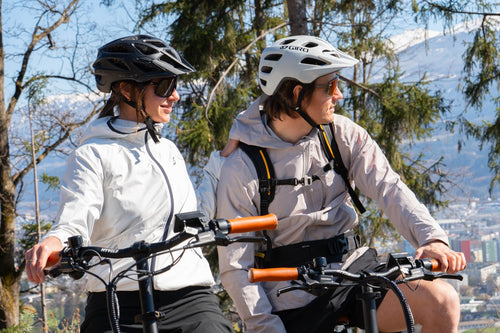
E-bikes with pedal assistance up to 25 km/h – often also referred to as pedelecs – are by far the most popular type of e-bike in Germany and Europe. They combine comfort, everyday usability, and fitness in a way that hardly any other means of transport offers. But what exactly is behind the 25 km/h limit? And for whom is such an e-bike particularly worthwhile?
By Paul Gerhardt 2 minutes read time

An e-bike with a 25 km/h top speed is technically a Pedelec (Pedal Electric Cycle). This means:
The motor only assists when you pedal yourself
Motor assistance cuts off at 25 km/h
The motor's maximum continuous power is typically 250 watts
Important: As soon as you ride faster than 25 km/h, the assistance automatically switches off – you then continue riding solely under your own muscle power.
A major plus point of this category is its ease of use in everyday life:
No insurance required
No driver's license needed
No helmet mandatory (but recommended)
Use of bike paths permitted
This makes these e-bikes almost identical legally to traditional bicycles – a decisive advantage over faster S-Pedelecs (45 km/h).
A pedelec is extremely versatile. The following especially benefit:
Those who commute to work daily save time and arrive more relaxed. Especially in the city, you are often faster than by car.
The assistance helps to cover longer distances even without top fitness.
You can set targeted training stimuli – e.g., by using less assistance or going on longer tours.
Joint-friendly riding and additional safety through motor assistance.
The range depends on several factors:
Battery capacity (e.g., 400 Wh, 500 Wh, 750 Wh, 800 Wh)
Assistance level
Terrain (flat vs. hilly)
Weather (wind!)
Typical ranges:
40–80 km with intensive use
80–150 km with moderate assistance
👉 Tip: If you plan longer tours, you should consider a larger battery or a spare battery.
Most modern e-bikes use mid-drive motors because they:
provide natural power transmission
offer good weight distribution
operate particularly efficiently
Alternatively, there are:
Front hub motors (affordable, but less dynamic)
Rear hub motors (sporty, direct riding feel)
When buying a 25 km/h e-bike, the following factors play a central role:
Capacity (min. 300 Wh for daily use)
Charging time
Replaceability
Important for inclines
35 - 120 Nm are common
Particularly relevant for transport and handling
Hydraulic disc brakes are standard and recommended
City, trekking, MTB, or folding bike?
| Feature | 25 km/h E-bike | S-Pedelec (45 km/h) |
|---|---|---|
| Driver's license | ❌ No | ✅ Yes |
| Insurance | ❌ No | ✅ Yes |
| Bike path allowed | ✅ Yes | ❌ Mostly not |
| Helmet mandatory | ❌ No | ✅ Yes |
👉 Conclusion: For everyday use, the 25 km/h e-bike is usually the better choice.
Even with motor assistance, e-biking remains real training:
Cardiovascular system is activated
Calorie consumption increases
Joints are protected
Studies show: E-bike riders often exercise more frequently and longer than traditional cyclists.
A 25 km/h e-bike is the perfect all-rounder:
Ideal for everyday life and leisure
Legally uncomplicated
Flexible and efficient
Promotes health
Whether for commuting, relaxed tours, or sporty sessions – a pedelec offers an excellent combination of comfort, performance, and freedom.