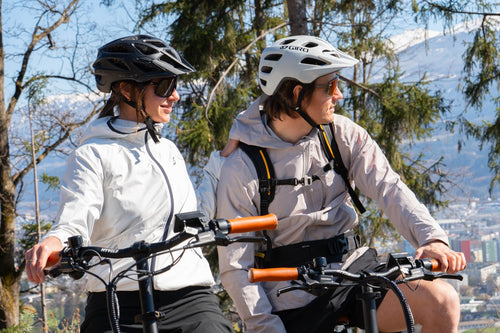
Electromobility is currently changing the way we get around in everyday life. Alongside traditional bicycles and cars, electric two-wheelers are becoming increasingly important. One question that frequently arises is: Is an e-bike actually a better moped?
By Daniel Rudat 3 minutes read time | Published: March 18, 2026

At first glance , e-bikes and e-mopeds seem similar. Both have an electric motor, both are quiet, and both offer relaxed transportation without gasoline. But on closer inspection, there are crucial differences – legal, technical, and in everyday use.
This article explains how e-bikes and e-mopeds differ, what their advantages and disadvantages are, and which vehicle is suitable for whom.
In everyday language, the term e-bike is often used incorrectly. Strictly speaking, most electric bicycles are pedelecs .
A pedelec only provides motor assistance to the rider when the rider is pedaling.
Typical characteristics of a pedelec:
Motor assistance up to 25 km/h
Motor power up to 250 watts
Assistance only while pedaling
No driver's license required
No insurance obligation
Use on cycle paths permitted
This means that, legally, a pedelec is considered a bicycle .
This is a huge advantage, especially in everyday life. You can use bike paths, travel flexibly through cities, and don't need license plates or insurance plates.
An electric moped works differently. Here, the electric motor takes over the entire propulsion.
Typical characteristics of an electric moped:
Speed usually 20–25 km/h
Throttle grip or twist grip instead of pedal assistance
Compulsory insurance
Moped test certificate or driver's license required
License plate required
Use of cycle paths is usually not permitted
This means that the e-moped legally falls into the category of small motorcycles , similar to a classic moped or a scooter.
| feature | E-bike (pedelec) | E-moped |
|---|---|---|
| Motor support | only when pedaling | regardless of pedaling |
| Maximum speed | 25 km/h | approx. 20–25 km/h |
| Driver's license | not necessary | necessary |
| Insurance | no | Duty |
| mark | no | Yes |
| Cycle paths | allowed | mostly forbidden |
| Movement | active | passive |
The biggest difference, therefore, lies in whether you have to pedal yourself or not .
E-bikes have become massively popular in recent years. Millions of e-bikes are now sold in Germany every year , while classic mopeds are becoming increasingly rare.
There are several reasons for this.
With an e-bike you can:
Use cycle paths
driving through parks
Taking shortcuts
Getting through city centers is easier
In contrast, an electric moped often has to share space with cars .
This is a clear disadvantage, especially in cities.
An electric moped requires:
Insurance license plate
regular insurance costs
Driving licence or moped test
An e-bike, on the other hand, can simply be bought and ridden.
This makes it particularly attractive for:
commuter
Students
older people
Occasional drivers
A crucial point: People are moving.
Even with motor assistance, cycling remains a physical activity.
Studies show that e-bike riders frequently:
cover more distance
drive more often
remain more active in the long term
An electric moped does not offer this effect, of course.
An e-bike is extremely cheap to operate.
Typical electricity costs per 100 km:
less than €0.50
Join in:
no insurance
no vehicle tax
minimal maintenance
An electric moped is also economical, but it incurs ongoing insurance costs .
Nevertheless, there are situations in which an e-moped can have advantages.
For example:
1. If you don't want to kick
Some people simply don't want to exert themselves physically .
2. For very short distances
For extremely short distances, a throttle grip can be more practical.
3. If you already use a scooter
Those who already ride a two-wheeler with a motor often feel more comfortable with an e-moped.
Interestingly, modern e-bikes are becoming increasingly powerful technically.
Today, for example, there are:
lightweight e-bikes under 20 kg
Ranges of 100 km and more
very powerful mid-engines
integrated lighting and displays
Many models now feel almost as powerful as a small moped – only with pedal assistance .
Lightweight urban models are especially suitable for:
Commute
City traffic
daily errands
For most people, the answer is: Yes.
An e-bike combines the advantages of a bicycle with the support of a motor:
flexible in road traffic
no insurance
no driver's license
low operating costs
health benefits
While an electric moped can be convenient, it comes with significantly more regulation and restrictions .
Those seeking a fast, sustainable and flexible mobility solution are therefore usually better off with a modern e-bike.
✅ Tip: Particularly lightweight e-bikes are ideal for everyday use, as they are very comfortable to ride even without a motor – an advantage over many heavier electric two-wheelers.