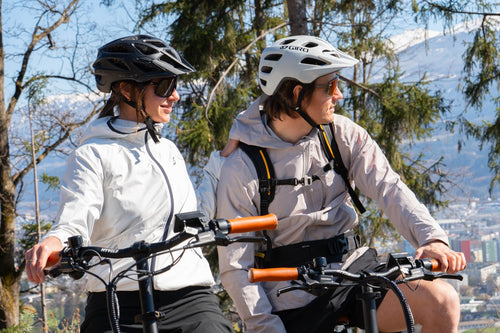
When people think about the topic of "alcohol and cycling," they usually immediately think of the blood alcohol limit . But the reality in urban traffic is more complex. It's not just alcohol that increases the risk – typical city hazards such as dooring, heavy traffic, poor visibility, and distractions also play a key role.
By Fabian Huber 4 minutes read time


Published: February 18, 2026 | Updated: February 18, 2026
Anyone who travels regularly in the city knows: It is often fractions of a second that decide safety.
In our article on the 👉 blood alcohol limit for cycling, we explain in detail when it becomes legally problematic and what penalties are imposed. But beyond the pure blood alcohol level, it's worth taking a look at the actual sources of danger in everyday life.
In Germany, the legal blood alcohol limit for absolute unfitness to ride a bicycle is 1.6 per mille . However, even below this level it can be dangerous – especially if other risk factors are present:
reduced reaction time
impaired perception
poorer judgment of speed
Tunnel vision
Especially in city traffic, attentiveness is the most important safety factor. And here, dangers lurk that have nothing to do with alcohol – but rather with infrastructure and the behavior of other road users.
Dooring describes an accident in which a driver or passenger opens the door without paying attention to cyclists. The cyclist either collides with the door or swerves reflexively – often directly into oncoming traffic.
Typical scenarios:
The cycle path runs directly next to the parking lane
Drivers only look behind them, not in the mirrors.
Passengers carelessly open the door
Darkness or poor visibility conditions
Minimal reaction time
A car door opens within seconds. Anyone traveling at 20–30 km/h has hardly any chance to avoid it.
Chain reactions
Evasive maneuvers often lead to collisions with other vehicles.
Serious injuries
Head, shoulder and collarbone injuries are particularly common.
Alcohol can be an additional risk factor here – but it doesn't have to be. Even when sober, dooring is one of the most frequent causes of accidents in urban cycling.
City traffic means:
Delivery traffic
E-scooter
buses
turning vehicles
parked cars
suddenly changing lane guidance
Many accidents occur when cars turn right. The blind spot remains a key problem.
The more complex the traffic situation, the more important it is:
clear positioning on the roadway
early communication
good visibility
Many accidents happen at:
dusk
Night
Rain
poor street lighting
Especially in cities, the importance of rear lights is often underestimated. Yet visibility is crucial for being noticed – particularly by vehicles approaching from behind.
Modern systems like the Garmin Varia RTL515 combine a rear light with radar technology. This technology can:
Detect approaching vehicles
warn acoustically or visually
Show distances
increase light intensity upon approach
This offers several advantages, especially in urban traffic:
✔ You get warned earlier
✔ You can position yourself better
✔ You can tell whether an evasive maneuver is safely possible
Important: Such systems do not replace vigilance - they merely increase the safety margin.
With e-bikes and fast pedelecs, average speeds in city traffic increase significantly. This means:
shorter reaction windows
higher impact energy
longer braking distances
The faster you travel, the greater the impact of distractions or reduced concentration. This brings us back to the topic of blood alcohol content:
Even minor restrictions can have serious consequences at higher speeds.
Another underestimated factor is cognitive load:
navigation
Traffic signs
pedestrian
turning vehicles
background noise
The brain processes enormous amounts of information in fractions of a second. Any additional limitation – fatigue, stress, or alcohol – reduces reaction time.
Maintain a distance of at least 1 meter – even if that means driving further to the left.
Small movements in the mirror can indicate an impending door opening.
Reduce your speed on narrow streets.
Bright, dynamic taillights increase visibility.
Driving too far to the right practically invites others to overtake.
Legally, the primary responsibility lies with the driver if a car door is opened without sufficient care. However, the following also applies to cyclists:
Contributory negligence is possible
Passing too closely can be problematic.
Excessive speed exacerbates the situation.
Therefore, a holistic view of safety is worthwhile – not just blood alcohol levels.
Accidents involving cyclists predominantly occur in urban areas. The most common types are:
Turning accidents
Dooring
Intersection situations
Conflicts with parked vehicles
Alcohol plays a role – but infrastructure and attention are more crucial.
Radar taillights, brake light functions, bright LED systems, or even door warning systems in modern cars can help.
But the crucial point remains: security begins in the mind.
Technology can provide support, but it does not replace driving skills or defensive behavior.
Although this article focuses on urban dangers, the legal dimension remains crucial.
For those who want to know:
When does it become a criminal offense?
What penalties are threatened?
When a medical-psychological assessment (MPU) is ordered
What applies to e-bikes
Find all the details here: 👉 Alcohol and bicycles: What penalties are imposed?
Ultimately, a reduced reaction time – whether due to alcohol, distraction or being overwhelmed – can have fatal consequences in city traffic.
The discussion about the blood alcohol limit is important. But it doesn't go far enough.
Dangers in urban traffic arise from:
Car doors suddenly opened
high traffic density
poor visibility
increasing speeds
lack of attention
Dooring is not a fringe problem – it's a real risk for everyone traveling in urban areas. Therefore, anyone who cycles regularly should:
✔ drive defensively
✔ Keep your distance
✔ be visible
✔ Use modern technology effectively
✔ and of course be sober while traveling
Because in the end, it's not just about fines or penalty points – it's about your own health.