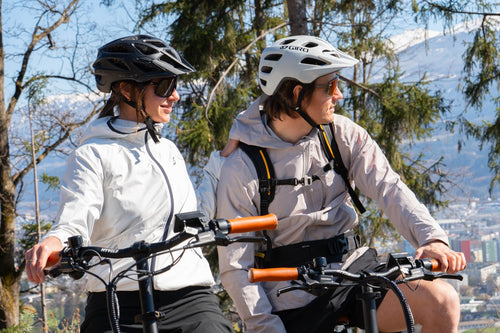
Rugged forest paths, stony trails, muddy forest roads – if you want to travel off-road, you need the right vehicle. Off-road capable e-scooters have been promising adventure without pedaling for several years. At the same time, e-MTBs have long established themselves as serious off-road machines. But what is really the better choice for true off-road riding? We honestly compare both concepts – from off-road capability to the legal situation in Germany.
By Vincent Augustin 5 minutes read time


Published: June 9, 2026 | Updated: June 9, 2026
Off-road e-scooters are built much more robustly than the familiar city scooters from sharing providers. They are equipped with:
These scooters can boast impressive technical specifications: top speeds of 50–80 km/h, partly over 100 km range (manufacturer-specified) and motors that can temporarily deliver several kilowatts. Sounds convincing at first – but let's look at practical use.
The off-road e-bike is the e-MTB (electric mountain bike). Whether as a hardtail with suspension fork or a full-suspension model: an e-MTB is designed from the ground up for uneven terrain.
Typical features:
MYVELO offers e-MTBs like the Himalaya and the Stelvio E-MTB Fully, which were developed precisely for these requirements.
| Criterion | Off-road E-Scooter | E-MTB |
|---|---|---|
| Off-road capability | Medium – good on gravel, limits on technical trails | Very high – designed for all types of terrain |
| Suspension travel | 50–120 mm (often poorly implemented) | 100–180 mm (high-quality, tuned) |
| Track width / Footprint | Narrow, standing – unstable in turns | Wide, seated – body-controlled riding |
| Motor power | 500–3,000 W (often needs to be throttled) | 250 W nominal power (up to 85 Nm) |
| Range (real) | 30–70 km | 50–120 km |
| Weight | 20–40 kg | 20–28 kg |
| Legality off-road (DE) | Only on approved paths, often not legal | Only on approved paths, same rules |
| Price (entry-level) | from approx. €800 | from approx. €2,500 |
| Physical exertion | Low (standing, static) | Medium (active, upper body involved) |
| Safety in case of fall | High (speed, standing position) | Lower (seated, body control) |
Off-road e-scooters are quite usable on paved gravel roads, forest roads, and easy off-road sections. However, as soon as it gets technical – roots, stones, steep descents, tight turns – they quickly reach their limits:
Standing position: The center of gravity is high, the standing area is narrow. In uneven turns or with sudden obstacles, there is no way to actively react with body weight. The risk of falling is significantly higher than on an e-MTB.
Small wheels: Even 10-inch wheels are smaller than the smallest MTB wheel (26 inches). They roll less effectively over obstacles, tend to dig into soft ground, and offer less traction on slopes.
Suspension often undersized: While the suspension forks installed on many off-road scooters are present, their quality is often far from what an MTB suspension system offers. Damping and responsiveness are rarely optimized for true off-road use.
An E-MTB Fully is designed from the ground up for technical terrain. Wide tires with an aggressive tread, well-thought-out frame geometries with a low center of gravity, and tuned suspension systems allow for riding that would simply not be possible with an e-scooter.
The mid-mounted motor – e.g., a Bosch Performance CX with 85 Nm – transfers power directly via the chain and drivetrain. This ensures more natural handling and better traction on the rear wheel, especially on steep off-road climbs.
In addition: the rider is seated. This sounds trivial but makes all the difference. While seated, you can actively shift your center of gravity, push the bike through turns, and absorb impacts from obstacles. This is simply not possible on a scooter.
Off-road e-scooters sometimes advertise enormous range figures. These values are achieved under ideal conditions: flat ground, constant speed, no headwind. Off-road – with inclines, changing surfaces, frequent acceleration – these values often halve.
E-MTBs have more realistic manufacturer specifications because the testing methodology (e.g., Bosch Range Check) is closer to real conditions. With a large battery (625–750 Wh) and an efficient mid-mounted motor, 60–100 km on demanding trails are possible – depending on the assistance level and terrain.
Another factor: Range anxiety is easier to manage with an e-MTB, because in the worst case, you can still actively pedal. An e-scooter without power is – especially off-road – barely movable.
This is an often underestimated point. In Germany, the same basic principle applies to both types of vehicles off-road: riding is only permitted on publicly approved paths.
Most powerful off-road scooters with motors over 250 W and speeds over 20 km/h are not approved for road use in Germany and therefore not legal to ride on public paths. They do not fall under the e-scooter regulation (which allows a maximum of 20 km/h and 500 W) nor under any other vehicle category with road approval.
This means: Anyone riding a high-powered off-road scooter on a forest path is operating in a legal gray area or simply illegally. Private property with explicit permission is the only safe alternative.
An e-MTB as a pedelec (motor assistance up to 25 km/h, max. 250 W nominal power) is legally considered a bicycle in Germany. It can be ridden on all paths designated for bicycles – including forest roads accessible to cyclists.
For singletracks and nature reserves, regional regulations apply. Many federal states have special regulations for MTBs. Principle: Only ride on designated paths, respect nature conservation.
| Aspect | Off-road E-Scooter (>500 W) | E-MTB (Pedelec up to 25 km/h) |
|---|---|---|
| Road legal | No (mostly not) | Yes (like a bicycle) |
| Driving license required | Possibly moped license required | No |
| Helmet | Recommended, partly mandatory | Recommended, not mandatory |
| Insurance | Possibly required | Not required |
| Forest roads | Often not legal | Allowed on designated paths |
In normal city traffic, an e-scooter is a comfortable solution. Off-road, however, the standing position becomes a real safety risk:
E-MTB riders sit, have pedals as active points of contact, and can control the bike through body movement. Paired with a helmet – ideally a full-face helmet on technical trails – the e-MTB is the significantly safer vehicle off-road.
Off-road e-scooters are an exciting concept – and certainly interesting for casual off-road excursions on private land. But for serious off-road riding: technical trails, real climbs, longer tours in nature, you can't get past the e-MTB.
The e-MTB is specifically designed for off-road use, clearly classified legally, and offers a riding experience that no scooter can replicate. With models like the Himalaya E-MTB or the Stelvio E-MTB Fully, you have vehicles that truly follow you off-road – and don't give up at the first root section.
If you are still unsure which motor type is right for off-road riding, our article E-Bike: Which motor really suits you? will help you further.