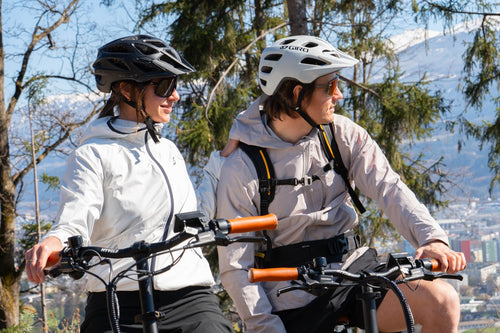
The e-bike has fundamentally changed the bicycle market in recent years. More and more people are using electrically assisted bicycles for commuting, touring, or simply for more enjoyment in everyday cycling. Especially in cities, the e-bike is increasingly becoming a genuine alternative to the car.
By Fabian Huber 5 minutes read time


Published: March 12, 2026 | Updated: September 17, 2026
But what exactly is a pedelec ? Many people use the term synonymously with "e-bike," although there are important technical and legal differences. Anyone who looks into the topic quickly realizes: The term pedelec describes a very specific type of electrically assisted bicycle.
This article explains exactly what a pedelec is, how it differs from a classic e-bike, what advantages it offers, and what you should pay attention to when buying one.
The term pedelec stands for "Pedal Electric Cycle". It refers to a bicycle with an electric motor that only assists the rider when they are pedaling.
This means that the motor provides additional power but does not replace the rider's own muscle power. The riding experience therefore remains very close to that of a classic bicycle – only with significantly less effort.
A pedelec is clearly defined in the European Union. Its most important characteristics are:
Motor assistance only when pedaling
Assistance up to a maximum of 25 km/h
Maximum motor power 250 watts
The engine switches off automatically above 25 km/h.
Legally, a pedelec is therefore considered a normal bicycle . This has several advantages: You don't need a driver's license, license plate, or insurance. Furthermore, you are allowed to use bike paths and are subject to the same traffic rules as a conventional bicycle.
It is precisely this combination of support and ease of use that makes the pedelec so popular.
In everyday language, the term e-bike is often used as a catch-all term for all bicycles with a motor. Strictly speaking, however, this is not correct.
A classic e-bike can also be ridden without pedaling – similar to a small moped. The motor can be activated via a throttle or button. As a result, such vehicles are often legally classified as light motorcycles.
With a pedelec, it's different: The motor only provides support and only works when you are pedaling yourself.
The most important differences at a glance:
| feature | e-bike | E-bike |
|---|---|---|
| Motor support | only when pedaling | also possible without pedaling |
| Top speed | 25 km/h | often faster |
| Driver's license | not required | partially required |
| Insurance | not required | frequently required |
| Use of cycle paths | allowed | partially restricted |
In practice , most "e-bikes" sold are actually pedelecs . However, the term e-bike has become established in common usage.
The popularity of e-bikes has increased enormously in recent years. There are several reasons for this, related to both comfort and practical advantages in everyday life.
With electric assistance, significantly longer distances can be covered. Commuters can therefore easily travel distances of 10, 15 or even 20 kilometers to work.
Inclines or headwinds lose their terror because the engine supplements the user's own power.
Despite the motor, the pedelec remains an active means of transport . You still pedal yourself and exercise regularly.
This has a positive effect on:
cardiovascular system
Muscles
Endurance
general well-being
Many studies even show that e-bike riders often travel longer distances than traditional cyclists – and therefore get more exercise overall.
Especially in urban areas, a pedelec can replace the car on many journeys. Particularly for short and medium distances, the electrically assisted bicycle is often even faster.
Everyday benefits:
No need to search for parking
lower mobility costs
less traffic stress
environmentally friendly
In addition, rising fuel prices are making cycling increasingly attractive from an economic standpoint.
Many people are rediscovering cycling through e-bikes. The electric assistance makes for a more relaxed ride and allows you to enjoy longer tours.
Beginners and those returning to the sport especially benefit from the fact that physical limitations are less noticeable.
The market for e-bikes has grown significantly in recent years. Today, there is a suitable model for almost every purpose.
City e-bikes are specifically designed for everyday use. They offer a comfortable seating position, practical features, and are perfect for short trips around town.
Typical features include:
upright sitting position
luggage rack
Mudguards and lighting
comfortable entry
Trekking e-bikes are versatile all-rounders. They are suitable for both daily commutes and longer bike tours.
They often have:
high-performance batteries
robust components
comfortable geometry
long ranges
SUV e-bikes are a relatively new category. They combine features of trekking bikes and mountain bikes and are particularly versatile.
They are suitable for:
Daily life and commuting
gravel roads
longer tours
easy terrain
Folding e-bikes can be folded up to save space. This makes them particularly practical for commuters or travelers.
They fit, for example:
in the trunk
in small apartments
by train or camper van
E-mountain bikes are specifically designed for off-road use. They feature powerful motors, wide tires, and high-performance suspension.
This makes it easy to tackle even steep inclines in the terrain.
Anyone wanting to buy a pedelec should consider several important factors. These determine how well the bicycle suits their intended use.
The motor is the heart of a pedelec. Modern systems ensure smooth and natural assistance.
Mid-mounted motors are particularly common, as they offer good weight distribution and a very natural riding feel.
Well-known manufacturers include, among others:
Bosch
Shimano
Bafang
Battery capacity is specified in watt-hours (Wh) and has a direct impact on the range.
Typical sizes are:
400 Wh for shorter distances
500–625 Wh for tours
750 Wh for maximum range
However, the actual range of an e-bike also depends on other factors, such as:
Support level
Driver's weight
Route profile
Weather conditions
A well-fitting frame is crucial for comfort and riding enjoyment. Important factors include:
the correct frame size
an ergonomic seating position
a comfortable saddle
easily accessible controls
High-quality brakes and stable wheels also contribute significantly to safety.
Anyone looking for a modern pedelec for everyday use, commuting or longer tours will find a wide selection of models with powerful motors and large batteries today.

The pedelec combines classic bicycle technology with modern electric mobility. The electric assistance makes longer distances easier, increases riding comfort, and makes cycling more attractive to many people again.
At the same time, the pedelec remains an active means of transport, where movement and riding enjoyment are the main focus.
It is therefore no wonder that pedelecs are among the most popular bicycles in Germany today – both in everyday life and in leisure time.
Get advice from cycling enthusiasts