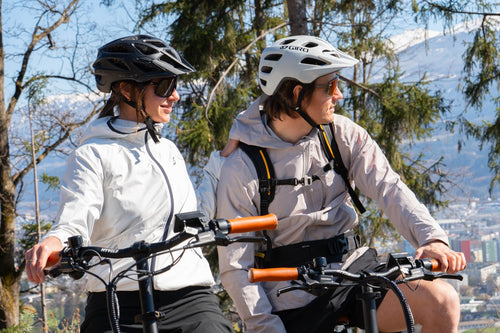
I am passionate about cycling. For years. In the rain, in the cold, through city traffic, over country roads. For me, the bicycle is not a second-class means of transport – it's my favorite.
By Fabian Huber 5 minutes read time


Published: June 3, 2026 | Updated: June 3, 2026
And that's precisely why a statistic gives me pause, one that shouldn't go unmentioned on today's World Bicycle Day: According to the ADFC Cycling Climate Test, 70 percent of respondents feel unsafe on German roads. More people on bikes – and yet the feeling that it's getting more dangerous? That's not a contradiction. That's a system failure.

Anyone on a city bike path today shares the space with a variety of vehicles that hardly anyone would have predicted ten years ago: road cyclists traveling at 35 km/h, e-bikes with assistance up to 25 km/h, e-scooters, cargo bikes with child transport, inline skaters, pedestrians lost in thought staring at their smartphones. All this on a strip that, in many German cities, is no wider than an open car door.
This plurality is actually a success story: cycling has become more vibrant and diverse than ever before. But without adapted infrastructure, diversity turns into chaos – and chaos creates fear. The reduced perception of safety is not a matter of attitude. It is a direct consequence of infrastructure that simply wasn't built for this reality.
If you want to know how Germany needs to evolve, you should visit Utrecht. The Dutch city regularly ranks among the top spots in the Copenhagenize Index, the most internationally respected ranking for cycling-friendly cities – most recently securing first place alongside Copenhagen and Amsterdam. Not because Utrechters are particularly sporty or disciplined. But because their city was built for bicycles.
Specifically, this means:
Physical separation instead of ground markings. In Utrecht, bicycles don't share space with cars – they get their own space. High curbs, bollards, and greenery act as separating elements. No gutter that a truck drives over, half-blocking the bike path in the process.
Protected intersections. The so-called "Dutch Junction" design places cyclists in the line of sight of turning cars. The risk of the blind spot – one of the most common causes of serious bicycle accidents – is eliminated structurally, not by appeals for attention.
Green waves for bikes, not for cars. If you cycle at a normal pace in Utrecht, you hit green lights. This is no coincidence, but rather traffic management policy: the flow of traffic is aligned with bicycles, not with the traffic light phases of motorized vehicles.
The world's largest bicycle parking garage. Utrecht Centraal main station has an underground bicycle garage with approximately 12,500 parking spaces. Bicycles and public transport are conceived as a system, not as competitors. The e-folding bike embodies this idea on a personal level: compact enough for luggage racks on trains, powerful enough for the last mile from the station to the office – true multi-modality that doesn't wait for finished infrastructure.
The result: almost 60 percent of all journeys into Utrecht city center are made by bicycle. Not by athletes. By people taking their children to school, going to the supermarket, commuting to work.
The difference between Utrecht and a mid-sized German city is not culture. It is political will, translated into budget and building regulations. Here's what I expect:
No new road, no road renovation without simultaneous cycle path planning. That sounds obvious – but it isn't. Today, municipalities decide on a case-by-case basis whether a cycle path will be built. The result is a patchwork: a well-developed section, then 200 meters of gravel strip, then nothing at all. Patchwork doesn't build trust.
Everyday cycling doesn't stop at the city limits. Commuters traveling from the surrounding areas into the city often use federal or state roads today, where a narrow white line at the edge of the road is considered a cycle path. That's not an offer – that's an imposition.
Germany needs a national network of cycling superhighways: wide, paved, illuminated connections between towns and cities. The RS1 project currently under construction in the Ruhr metropolis – over 100 km of planned route between Moers and Hamm – shows that this is possible. It must become the rule, not the exception. For those who want to bridge the gap themselves until then: the e-folding bike fits into every regional and S-Bahn train and makes multimodal commuting practicable even without a cycling superhighway network today.
One of the biggest structural problems in Germany is the fragmentation of responsibilities. Municipal road planning, state and federal road law, public transport operators, police, school authorities – all affect cycling, yet hardly anyone coordinates systematically.
Utrecht has a simple but effective approach to this: There is a central cycling coordinator who brings together all planning across departmental boundaries. Nationwide, we need this at the city level as a requirement and at the state level as a regular institutional format. Not just one symposium a year. Permanent, interdepartmental working groups with budget and decision-making authority.
The Netherlands invests around 30 euros per inhabitant per year nationally in cycling infrastructure. In most German cities, bicycle planning is a sub-item in the civil engineering budget, which is cut when other projects become more expensive.
As long as cycle paths are built from residual funds, they will have residual quality. A dedicated, earmarked bicycle budget – similar to what many cities have for road and bridge maintenance – is not a utopia. It is the only way to guarantee continuity.
The growing diversity of vehicles on cycle paths is not a problem that can be solved by bans. Banning e-scooters from cycle paths without offering them an alternative only shifts the problem. What works is separating infrastructure by speed: fast connections for pedelecs and road bikes, relaxed everyday paths for cargo bikes and leisurely riders. This requires width – and that can only be achieved by taking space away from cars.
I am not an enemy of cars. I am an advocate for the right to safe mobility – and that applies to people on two wheels just as much as to people on four.
The evidence is clear. More cycling improves air quality, relieves congestion, reduces accident numbers, and prolongs lives – as shown by studies from Utrecht, Copenhagen, the Glasgow Meta-analysis, and Salzburg commuter trials. We know what needs to be done. We know how to do it. Utrecht shows the way.
What is missing is the political will to redistribute space. This hurts – for all those who are used to believing that road space primarily belongs to them. But this pain is temporary. The alternative is a permanent state where more and more people want to cycle but feel unsafe because no one has adapted the infrastructure.
For World Bicycle Day 2026, I don't wish for a campaign or a logo. I wish for concrete, steel, and funding approvals. I wish for traffic planners who meet once a month and work together to make cycling in Germany as natural as taking the bus.
And until then: I'll be back in the saddle tomorrow. I hope you will be too.