


Entdecke den MYVELO
E-Bike Onlineshop
Entdecke Dein Traum E-Bike im MYVELO Onlineshop. Direkt vom Hersteller Dein Fahrrad aussuchen.
The Battery Management System (BMS) is the electronic protection and control unit built into every e-bike battery. It continuously monitors all relevant parameters of the lithium-ion cells and intervenes before critical conditions occur. Without a BMS, the safe operation of a lithium-ion battery would not be possible.
The BMS fulfils four core functions:
Lithium-ion cells must not be charged beyond their rated voltage (typically: 4.2 V per cell). Overcharging leads to excessive heat generation, electrolyte degradation and, in extreme cases, thermal runaway. The BMS interrupts the charging process exactly at the cell's upper limit.
Equally critical is the complete draining of cells below a minimum voltage (typically: 2.5–3.0 V per cell). Deep discharge causes irreversible chemical changes in the anode. The BMS shuts down the battery before this point is reached – which is why the display often still shows 5–10% remaining capacity when the battery cuts out.
In summer, temperature monitoring is the most important BMS function. The system measures cell temperature in real time and responds in stages:
| Temperature | BMS response |
|---|---|
| Below 10 °C | Charging blocked or greatly reduced |
| 10–40 °C | Normal charging operation |
| 40–50 °C | Charging restricted, discharge power (motor) throttled |
| From 50–55 °C | Complete shutdown (protective cutoff) |
The BMS thus prevents the battery from being charged at too high a temperature – one of the most common causes of premature capacity loss in summer.
A battery pack consists of many individual cells connected in series and parallel. Individual cells age at different rates or have slightly different capacities. The BMS compensates for these differences during charging through cell balancing: it redirects excess charge from stronger cells to weaker ones. Without balancing, weaker cells would become overcharged or deeply discharged sooner – accelerating the ageing of the entire pack.
In the Bafang drive systems fitted to all current MYVELO e-folding bikes, the BMS is integrated directly into the battery housing. It communicates with the motor controller and display via the CAN bus. This means that display readings such as state of charge, temperature warnings and range estimates are direct BMS outputs.
Bafang BMS units typically operate with a protection trigger at 60 °C battery core temperature and a charging enable window of 5–45 °C – varying slightly depending on the battery model and firmware.
The BMS is a reactive protective unit, not a preventive one. It intervenes when limit values are exceeded – but it does not prevent heat build-up from external heat sources (sun, hot boot). Anyone who parks their battery in the sun during summer cannot rely on the BMS to fully avert damage. It can only respond once the core temperature is already critical.
A triggered BMS manifests itself through:
- Sudden motor stop with remaining capacity still displayed → overtemperature shutdown
- Charging does not start despite charger being connected → temperature below 10 °C or above 45 °C
- Error code on the display → depending on the system: specific code in the manual
- Battery charges extremely slowly → BMS is reducing charging current due to cell imbalance
In the event of persistent BMS malfunctions, a diagnostic check at a workshop is recommended – many systems allow detailed error readouts via diagnostic software.
The BMS is the invisible guardian of every e-bike battery. It is what makes the safe use of lithium-ion technology in everyday operation possible in the first place. Anyone who wants to keep their battery performing well for a long time works with the BMS – by storing it in the shade, allowing it to cool before charging and avoiding extreme temperatures.


Entdecke den MYVELO
Entdecke Dein Traum E-Bike im MYVELO Onlineshop. Direkt vom Hersteller Dein Fahrrad aussuchen.

Dein Traumrad
MYVELO hat einen Flagshipstore in Oberkirch und ist regelmäßig auf Messen vertreten. Komm in unseren Flagship Store und probiere Dein Traum Bike aus. Lass Dich von uns zu Deinen Anforderungen beraten.

Leasen statt kaufen
Spare mit Leasing! Finanziere Dein Traum E-Bike ganz einfach über Deinen Arbeitgeber. MYVELO unterstützt Dich im Leasing-Prozess bei Deinen Fragen.
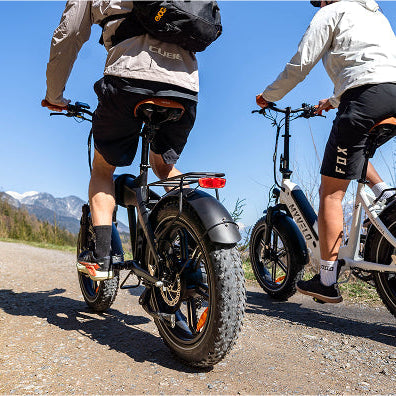
Simulating pedaling doesn't sound right at first – but what's actually behind it and which e-bikes make it possible?

Anyone traveling through Europe by bicycle, or even just renting a bike on holiday, quickly asks themselves: Is there actually a helmet requirement?
The answer isn't quite that simple. While some countries have clear regulations, others rely more on personal responsibility. Furthermore, even where there's no legal requirement, wearing a helmet is strongly recommended.
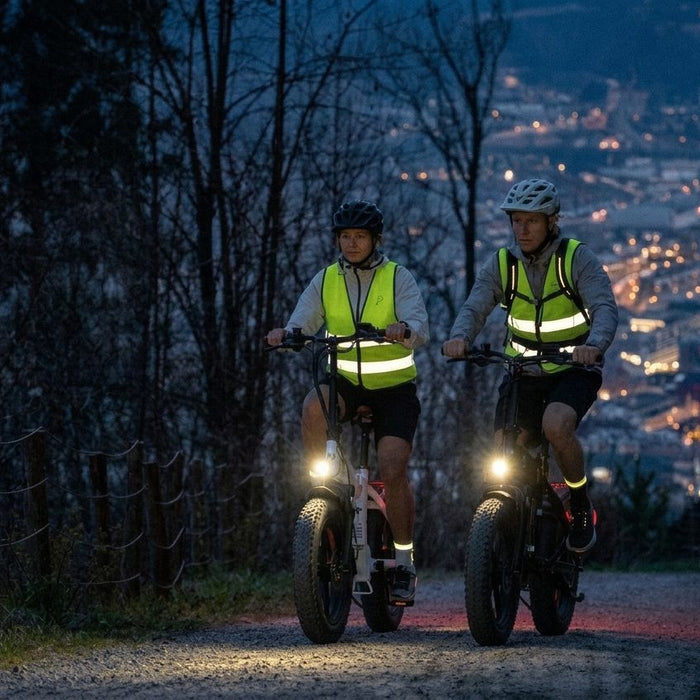
In autumn and winter, you often cycle to or from work in the dark. The question isn't just whether you have lights, but whether drivers can see you as a cyclist in time. A study involving nighttime rides on a closed road provides clear answers: the crucial factor is where the reflectors are positioned.