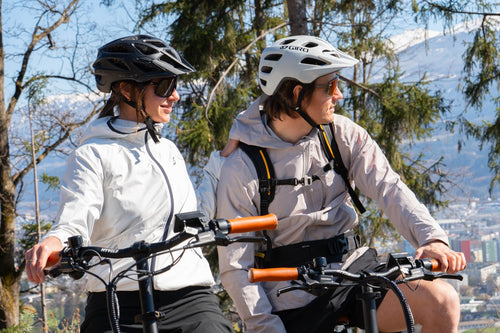
Anyone who rides a road bike knows that it's not just the training itself that determines performance and riding enjoyment, but also the preparation. A targeted warm-up before a ride prepares muscles, joints, the cardiovascular system, and even the mind for the exertion ahead. But what does an effective warm-up routine for road cyclists look like?
By Vincent Augustin 3 minutes read time


Published: September 19, 2025 | Updated: September 19, 2025
Before hopping on the bike and going full throttle, you should gradually warm your body up to operating temperature. This has several advantages:
Improved blood circulation: Muscles and tendons are better supplied with oxygen and nutrients.
Joint protection: Warming up increases joint fluid production, which reduces friction.
More power: The cardiovascular system doesn't start cold, but is prepared – this allows you to reach your optimal performance range more quickly.
Injury prevention: Warm-up reduces the risk of strains or muscular problems.
Mental focus: You switch from everyday life to sport.
During the warm-up, numerous processes take place in the body that are crucial for road cyclists:
Muscle temperature rises by 1–2 °C after just a few minutes of exercise. This increase improves:
the elasticity of muscle fibers (lower risk of injury),
the speed of contractions (one's footwork is smoother and more explosive),
the efficiency of enzymatic processes in energy metabolism.
During warm-up, the body primarily uses the slow-twitch muscle fibers (type I) , which are responsible for endurance. As the intensity increases, the fast-twitch fibers (type IIa and IIx) , which are important for sprints and accelerations, are also activated. A systematic warm-up therefore ensures that all fiber types are gradually "activated."
In the first few minutes, the muscles work primarily anaerobically (without oxygen), which can lead to lactate formation.
However, the warm-up continuously increases oxygen uptake (VO₂) until an equilibrium is reached.
This allows the body to efficiently switch its energy supply to aerobic energy production – ideal for longer periods of exertion on a racing bike.
Increased blood flow opens the capillaries in the muscles. This leads to:
improved nutrient supply,
faster removal of metabolic waste products
an improved "buffer function" against over-acidification.
The warm-up also improves neuromuscular coordination . This means:
Nerve signals reach the muscle fibers faster.
The movements – especially the pedaling motion – become smoother.
Strength and endurance can be accessed more efficiently.
👉 Especially in cycling, where economical power transmission and rhythmic repetitions of thousands of pedal strokes are crucial, this adaptation is essential.
Start with gentle movements without using the wheel to activate your joints:
Arm circles and shoulder circles – important for sitting posture.
Hip circles loosen the pelvic region, which needs a lot of stability when cycling.
Knee and ankle circles – to make the step more fluid.
In contrast to static stretching, here the muscles are actively moved.
Lunges with rotation – for hips, torso and legs.
Raising your knees high activates the thigh and hip flexors.
Leg swings forward and to the side prepare the leg muscles for pedaling.
Now it's time to get on the racing bike:
Start with a relaxed pedal stroke (90 rpm, low resistance).
Gradually increase the intensity.
After 5 minutes, incorporate short acceleration runs (each for 20 seconds slightly faster, then ride easily again).
👉 Tip: If you're using a stationary bike trainer, you can also do the warm-up indoors – practical for races or training intervals.
To ensure the body is truly "awake", the following are suitable:
Cadence intervals: 30 seconds at a very high cadence (110–120 rpm), followed by 1 minute easy. 3–4 repetitions.
Sprints in the saddle: 2-3 short bursts of 6-8 seconds each at full power.
Single-leg pedaling (on the trainer or slightly uphill): Improves pedaling technique.
Before a long basic training session: 10-15 minutes of easy rolling is sufficient.
Before intervals or a race: A more intensive warm-up with sprints and cadence work is mandatory.
In cold weather: Roll out for a longer time and ideally stay in motion before the actual exertion begins.
Drive off immediately without any warm-up.
Starting too hard – pulse and muscles shoot up before the body is ready.
Static stretching before driving can reduce performance in the short term.
Underestimate the importance of warm-up: especially during races or tough training sessions, it makes all the difference.
A warm-up only takes 15–20 minutes, but offers enormous performance and health benefits. Besides improved blood circulation and joint protection, it also ensures optimal muscle activation and energy metabolism . Whether it's training, a ride with friends, or a race – your body will thank you with better performance and a reduced risk of injury.
🚴 So: Don't go full throttle right away, but slowly ramp up the engine – then road cycling will run like clockwork!