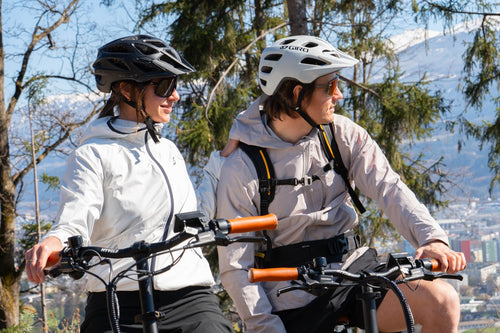
This article will tell you which vehicle is better suited to your everyday life, your driving style and your needs.
The difference at a glance
Before we go into the details, it is worth taking a brief look at the basic differences between electric scooters and fat bike e-bikes.
| feature |
electric scooter |
Fatbike E-Bike |
| drive
|
Electric motor (usually 500–3000 W) |
Electric motor (250–750 W) with pedal assistance |
| operation
|
Throttle grip, no pedaling required |
pedals + electric assist |
| reach
|
40–120 km depending on the battery |
50–150 km depending on battery and driving style |
| Permit
|
Insurance license plate required |
Pedelecs up to 25 km/h: no registration required |
| Helmet required
|
Yes |
No (up to 25 km/h) |
| Driver's license
|
From AM class (from age 15) |
No driver's license required |
| Movement factor
|
Low – you sit passively |
Up – you actively pedal. |
| Off-road capability
|
Only roads and cycle paths |
Also terrain, snow, sand, forest paths |
| Cost
|
approx. €1,000–3,000 |
approx. €1,500–4,000 |
Everyday mobility: City vs. Countryside
Electric scooters are the perfect solution for the city. They are compact, agile, and quiet – ideal for elegantly bypassing the morning traffic jam. Whether for work, the supermarket, or a meeting at a café: an e-scooter gets you to your destination relaxed and without breaking a sweat.
Fatbike e-bikes, on the other hand, demonstrate their strengths where other vehicles give up: on gravel roads, in snow, or on forest trails. They are the ideal combination of fun, exercise, and mobility. They also perform well in the city, especially if you want a more sporty ride.
👉 Conclusion:
Exercise & Health: Who gets you moving?
One clear difference: The electric scooter is purely passive transportation. You stand or sit – and let it drive you. It's comfortable, but not very physically demanding.
The fatbike e-bike, on the other hand, combines electric drive with physical activity.
You pedal, determine your pace and can adjust the motor assistance so that you either ride leisurely or train properly.
Furthermore, cycling has been scientifically proven to offer numerous advantages:
And the best part: With a fatbike e-bike, exercise is simply fun – whether on the way to work or on a weekend tour in the forest.
👉 Conclusion: If you want to stay fit , the fat bike e-bike is clearly at an advantage.
Environmental impact: Both clean – but not the same
Both electric scooters and e-bikes are emission-free . However, a closer look reveals differences:
-
Fatbike e-bikes are lighter, consume less energy and require smaller batteries.
-
Electric scooters often have larger batteries and consume more electricity due to their weight and higher speed.
E-bikes also usually perform better in terms of component lifespan – less power means less wear and tear.
Many people confuse a fat bike e-bike with an electric moped – after all, they both look similar at first glance and have motor assistance. But the difference is crucial: With an e-bike (pedelec), the motor only assists you as long as you pedal. A moped, on the other hand, can also be ridden without pedaling and is therefore legally classified as a light motorcycle – requiring registration, insurance, and a helmet.
👉 Conclusion: Both are environmentally friendly, but the fat bike e-bike has the edge due to its lower energy consumption and longer lifespan.
Driving experience & area of application
This is where the wheat is separated from the chaff.
Electric scooters:
-
It feels like a small scooter: you accelerate, and you roll along quietly.
-
Ideal for asphalt and short distances.
-
Not very suitable for uneven paths, cobblestones or steep inclines.
Fatbike E-Bike:
-
The wide tires (up to 4.8 inches) provide incredible grip – even on mud, snow or sand.
-
You can comfortably ride over roots, gravel and even curbs.
-
The motor ensures you remain relaxed on the road, even uphill.
👉 Conclusion: For adventurers, nature lovers, and anyone who wants more than asphalt: Fatbike e-bike. For city dwellers who want stress-free transportation: Electric scooter .
Cost comparison
A crucial factor for many buyers is the purchase and maintenance costs .
| Cost |
electric scooter |
Fatbike E-Bike |
| acquisition
|
€1,000–3,000 |
€1,500–4,000 |
| Insurance
|
Mandatory, approx. €50–100/year |
No obligation |
| maintenance
|
Engine, brakes, tires, and possibly vehicle inspection (TÜV). |
Chain, brakes, battery, tires |
| Battery charging cycles
|
approximately 500–800 |
approximately 700–1,000 |
| Energy consumption |
higher (larger battery) |
less |
| Leasing possible
|
part |
Yes, company bike leasing is possible. |
👉 Conclusion: In everyday use, the fat bike e-bike is usually cheaper to maintain . Thanks to company bike leasing, it can even be claimed as a tax deduction – a real advantage over electric scooters.
Range & Charging Times
Both vehicle types now offer solid ranges.
However, in practice, weight, driving style and battery quality play a major role.
-
Electric scooter: 40–120 km range, charging time approx. 5–8 hours
-
Fatbike e-bike: 50–150 km range, charging time approx. 4–6 hours
The e-bike scores points with its lower energy consumption and the ability to continue riding even without motor assistance – for example, when the battery is empty. With an electric scooter, on the other hand, you come to a standstill.
👉 Conclusion: When it comes to range, the fatbike e-bike has the edge – especially on longer tours.
Maintenance & Repair
Another difference becomes apparent in maintenance:
-
Electric scooters: more complex electronics, special spare parts, often require a workshop
-
Fatbike e-bike: classic bicycle technology, many components replaceable or self-serviceable.
Thanks to standardized e-bike technology (e.g. Bosch, Shimano, Bafang systems), you can find spare parts and service almost everywhere.
👉 Conclusion: The fat bike e-bike is easier to maintain and more cost-effective to service.
Weather & Seasons
Electric scooters struggle in rain, cold, or snow. Their small tires offer little grip, and the ride quickly becomes unsafe. Fat bikes, on the other hand, thrive in these conditions. Their wide tires provide stability on slippery surfaces, and the pedal assist keeps you moving – even in winter.
👉 Conclusion: If you want to ride all year round , the fat bike e-bike is the significantly better choice.
Conclusion: Which vehicle suits you best?
| category |
winner |
| City traffic & comfort
|
electric scooter |
| Health & Exercise
|
Fatbike E-Bike |
| Terrain & Adventure
|
Fatbike E-Bike |
| Environment & Energy Efficiency
|
Fatbike E-Bike |
| Costs & Maintenance
|
Fatbike E-Bike |
| Range & Flexibility
|
Fatbike E-Bike |
👉 Overall conclusion:
If you simply want to get from A to B comfortably, an electric scooter is a good choice. But if you're looking for a vehicle that combines exercise, freedom, and riding fun – and reliably accompanies you in any weather – there's no way around a fat bike e-bike . It's not only more sustainable, but also more versatile and sporty. And with company bike leasing or financing, getting started is easier than ever.
👉 Discover now: Fatbike e-bikes from MYVELO


 The Fatbike: Your ultimate guide to the fat tires