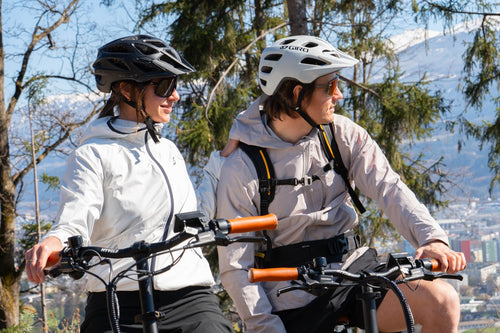
Cornering is one of the key skills on a bicycle – and at the same time one of the most underestimated. This is because the technique differs fundamentally depending on the intended use: while off-road you actively "push" the bike underneath you , on a road bike you usually lean into the curve together with the bike .
By Fabian Huber 3 minutes read time


Published: September 1, 2026
But when is which technique appropriate? And what physical processes are taking place behind the scenes? This article provides the answers.
Whether on an e-MTB or a racing bike – two key forces are at work when cornering:
Centrifugal force → pulls outwards
Weight force → acts downwards
To navigate the curve stably, these forces must be balanced. This is achieved through correct body posture and lean .

When racing bikes or fast e-bike tours on asphalt, the so-called laying technique is used.
Body and bicycle form a unit
They both lean into the curve together.
The center of gravity remains as stable as possible above the wheel.
Maximum possible speed
Even traction on both tires
Efficient in long, fast corners
road cycling
Fast commutes by e-bike
Asphalt roads
Press down on the outside pedal
Look through the curve
Hold the handlebars loosely – don't tense up.
👉 This technique is ideal when grip and speed are paramount.

The pushing technique is used in rough terrain, on trails or in technical sections.
Here, the opposite happens: 👉 The bicycle is pushed into the curve under the body , while the upper body remains more upright.
The body's center of gravity remains central or slightly to the outside.
The bike is actively leaned into the curve.
Arms and legs work dynamically
More control on loose surfaces
Improved balance at low speeds
Quick changes of direction possible
Mountain bike (trail, enduro)
Trial and technical sections
Gravel and loose subsoil
Pressure on the outside pedal when cornering
Actively move the bike among itself
Keep upper body stable
👉 This technique helps to maintain control even with low grip.
| criterion | Laying (racing bike) | Push (MTB) |
|---|---|---|
| posture | Inclined with the bike | Upper body upright |
| Bike movement | Hardly relative to the body | Active under the body |
| speed | High | Rather moderate |
| Subsoil | Asphalt, solid | Loose, technically |
| Goal | Efficiency & Speed | Control & Stability |
The choice depends heavily on three factors:
Asphalt → Laying
Gravel / Trail → Push
Quick → Lay
Slow / technical → Press
Wide curves → Laying
Tight turns → Push
→ Leads to insufficient grip at higher speeds
✔ Solution: Actively lean the bike into the curve
→ Increases the risk of slipping
✔ Solution: Push the bike, keep your body stable
→ You go where you look
✔ Solution: Always look through the curve, not at the ground
“Pushing” and “laying” are not opposites – but rather two tools that are used depending on the situation.
For speed and efficiency → Laying
For control and technology → Press
Those who master both techniques not only ride more safely, but also with significantly more confidence – whether on an e-bike, racing bike or mountain bike.
Especially with an e-bike, it's worthwhile to consciously practice both techniques. The increased weight and additional motor assistance change the riding characteristics – particularly in curves.
👉 Practice specifically:
Curves on an empty parking lot (Laying)
Slow slalom runs or trails (push)
This way you develop a better feel for the bike – and get the most out of every ride.