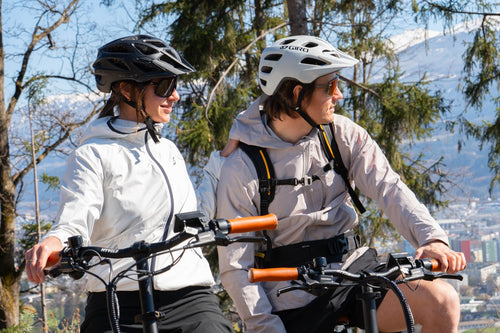
The idea of an e-bike evokes mixed feelings in many seniors. On the one hand, there's the desire to remain mobile, to exercise, and to manage daily life independently. On the other hand, doubts arise: What if their balance isn't as steady as it used to be? What if starting off becomes difficult, or they can't brake in time?
By Fabian Huber 3 minutes read time


Published: January 29, 2026
These concerns are neither unusual nor unfounded. As we age, our reaction time, strength, and mobility change. That makes it all the more important to take these fears seriously – and to address them with knowledge, experience, and the right technique.

One of the most common concerns relates to balance. Uncertainty arises particularly when starting, slowing down, or stopping. Many people fear the bike might tip over or be difficult to control.
An e-bike provides pedal assistance – but this can be unsettling. The worry of unintentionally going too fast or losing control is widespread, especially among riders who haven't been on a bike for a long time.
Hand strength often decreases with age. This leads to the fear of not being able to brake hard or quickly enough in an emergency, especially in confusing traffic situations.
Hip, knee, or back problems make mounting a bike over a high top tube difficult. Many crashes don't happen while riding, but precisely at these moments.

A common misconception is that e-bikes exacerbate these problems. In practice, the opposite is often true. A pedelec only provides assistance when pedaling – it doesn't move on its own. This results in a smooth, controllable motion.
Ascents or headwinds can be tackled without sudden bursts of power. This protects the cardiovascular system, reduces uncertainty, and ensures a smoother ride. Especially when strength is waning, this assistance can even improve balance instead of jeopardizing it.

Bicycles with low-entry or comfort frames allow for particularly safe mounting and dismounting. The leg only needs to be lifted slightly, which significantly reduces the risk of falling and increases the feeling of safety.
High-quality disc brakes offer strong, easily modulated braking performance – even with minimal hand force. This provides safety in critical situations and ensures short braking distances.
A well-tuned engine engages smoothly and accelerates without jerking. This is crucial for control and confidence, especially at low speeds.
An ergonomic, upright sitting posture not only improves visibility in road traffic, but also stabilizes balance and relieves strain on the back and joints.
Electric folding bikes offer several advantages, which are particularly important for those experiencing anxiety and insecurity. Their compact design makes them easier to control and maneuver.
There's also the practical aspect: the bike can be safely stored in the apartment or garage instead of being left outside. This not only reduces the risk of theft, but also the daily hassle of dealing with heavy locks or tight parking spaces.
For short, predictable everyday journeys – such as shopping or short trips – electric folding bikes are a particularly relaxed solution.

The return to work doesn't have to be perfect. The important thing is to take your time and find your own rhythm.
First drives in quiet surroundings, far away from traffic
Select a low support level
Take regular breaks
Adjusting the saddle and handlebars correctly
Use a test drive to build trust.
Often, a short, positive experience is enough to transform initial fear into new confidence.
Feeling unsafe while riding an e-bike at an older age is not a sign of weakness, but of a sense of responsibility. Modern e-bikes are designed to provide support, not to overwhelm. With the right equipment, a suitable frame, and a calm approach, an e-bike can help regain mobility and quality of life.
A test drive is often the moment when concern turns back into confidence – and reluctance into renewed enjoyment of movement.