This article will tell you how to calculate the optimal saddle height, which methods have proven effective, and which mistakes to avoid.
Why is the correct saddle height so important?
An incorrectly adjusted saddle height can lead to the following problems:
If the saddle is too low , the knee remains bent too much – the muscles work inefficiently.
If the saddle is too high , the pelvis tilts, the hip rotates, and tensile forces are created in the knee and lumbar region.
Especially in road cycling, for example on rides like over the Passo dello Stelvio, the correct seating position determines efficiency and endurance.
The most well-known methods for determining saddle height
1. The heel method (beginner method)
Here's how it works:
Sit on the bicycle (preferably leaning against a wall).
Position the crank vertically downwards.
Place your heel on the pedal.
Your leg should now be almost completely straight – without tilting your hip.
If you pedal later with the forefoot, a slight knee bend automatically results – ideal for efficient pedaling.
Advantage: Fast, uncomplicated, no measuring tools required
Disadvantage: Not highly precise
2. The LeMond Formula (sporting orientation)
Named after Greg LeMond.
Formula:
Stride length (cm) × 0.885 = saddle height (cm)
The measurement is taken from the center of the bottom bracket to the top edge of the saddle along the seat tube.
Example:
Stride length 85 cm × 0.885 = 75.2 cm saddle height
This method is particularly suitable for road cyclists who prefer a sporty seating position.
3. The knee angle method (bike fitting approach)
Here, the knee angle is measured at bottom dead center .
Ideally, the following should be:
This method is frequently used in professional bike fitting and is the most biomechanically precise.
Differences depending on the type of bicycle
road bike
Tend to be slightly higher
Focus on maximum power transmission
Aerodynamic seating position
mountain bike
E-bike
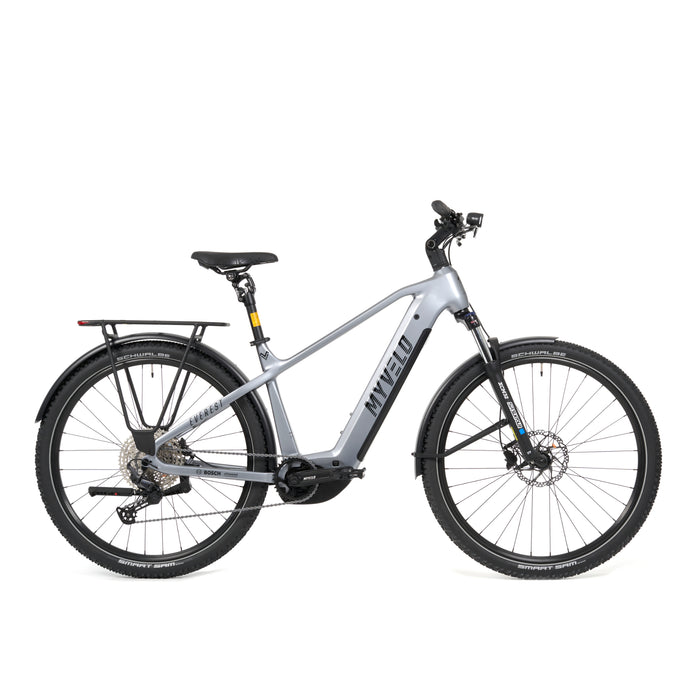
Especially with e-bikes with motor assistance , such as those with Bosch systems , the saddle height is often underestimated.
Because riders travel longer and more relaxed, small misalignments accumulate over many kilometers. Comfort plays a more significant role here than maximum aerodynamics.
Typical mistakes regarding saddle height
1. Saddle too high
2. Saddle too low
3. Adjust only by feel.
Body awareness is important – but without a basic orientation, the biomechanical foundation is missing.
Studies show that deviations of just 5 mm can have measurable effects on efficiency and oxygen consumption.
An optimal saddle height ensures:
This is particularly noticeable during long climbs or intense intervals.
Adjust saddle height if you experience discomfort
| Complaint | Possible cause |
|---|
| Anterior knee pain | Saddle too low |
| Posterior knee pain | Saddle too high |
| Back pain | pelvis tilts |
| Deaf feet | Hyperextension |
Important: Always make changes in small increments of 2–3 mm and test on several trips.
Fine-tuning: More than just the height
The perfect sitting position also includes:
Saddle height is therefore the first, but not the only step towards the optimal setup.
Conclusion: Small adjustment, big impact
The correct saddle height is one of the biggest performance levers in cycling – and at the same time one of the most common sources of error.
Whether you're enjoying a leisurely e-bike ride or training ambitiously on a racing bike: a correct setup ensures more comfort, fewer injuries and better performance.
Anyone who wants to ride without discomfort in the long term should take the time for a proper bike fit - or invest in a professional bike fitting .