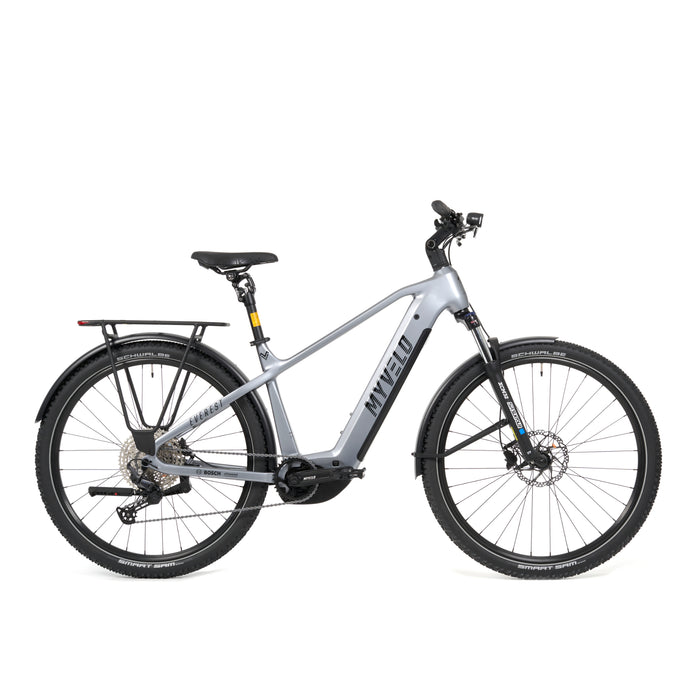
Why charging at the employer makes sense
Many e-bike riders know that a dead battery can quickly spoil the fun of commuting. Charging at work has several advantages:
-
Flexibility: Even on longer journeys, you don't have to worry about getting stuck halfway through.
-
Cost savings: Instead of using expensive fast charging stations on the go, you can charge your battery for free at your employer's premises.
-
Motivation for commuting: People who know that the battery can be charged safely are more likely to ride their e-bike – good for health and the environment.
What prerequisites are necessary?
To ensure that charging at the employer's premises goes smoothly, a few points should be considered:
-
Power outlets and capacity: Ideally, there should be an easily accessible area with standard power outlets. Check whether the power consumption is sufficient for multiple e-bike batteries simultaneously.
-
Secure parking: A secure bicycle parking area protects against theft and weather damage. Some employers even provide lockable charging boxes.
-
Agreement with the employer: Especially in larger companies, it is advisable to officially clarify the use of electrical sockets to avoid misunderstandings.
Practical tips for charging
-
Timing: It is best to charge the battery during working hours, e.g. overnight or during office hours.
-
Fast chargers: Some e-bikes support fast charging. Check if your workplace allows this, as fast chargers draw more power.
-
Battery care: Charge the battery regularly, but do not overcharge it. An optimal charge level is between 20% and 80%.
-
Extension cords: In some offices, power outlets are difficult to reach. A high-quality, short extension cord can help.
Legal and tax aspects
In Germany, employers are generally allowed to provide electricity for private e-bikes. In some cases, this can even be tax-advantageous.
-
Tax-free energy: If the employer provides electricity free of charge, this is considered a tax-free energy supply, similar to company cars.
-
Mileage allowance vs. electricity costs: Those who use the e-bike as a company bike can still claim the mileage allowance; electricity is usually included.
Conclusion
Charging your e-bike battery at work is not only convenient, but also a real motivator for commuters. With a little planning – secure parking spaces, suitable power outlets, and keeping an eye on battery maintenance – the commute can be comfortable and stress-free. Those who take advantage of this option enjoy a relaxed ride, remain flexible, and contribute to greater sustainability in everyday life.