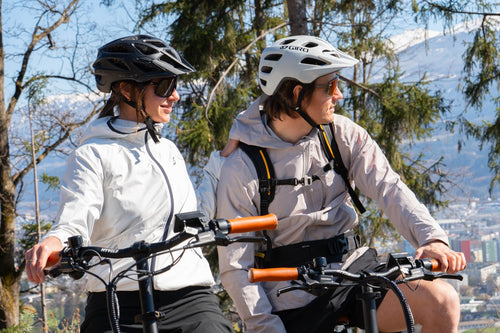
E-bikes have experienced a real boom in recent years. More and more people are switching from traditional bicycles to e-bikes – whether to cover longer distances in a relaxed manner, to manage their commute without much effort, or simply to rediscover the joy of cycling. But especially for beginners, the question often arises: How does an e-bike actually work?
By Helena Burgardt 2 minutes read time


Published: March 7, 2026 | Updated: September 4, 2026
An e-bike is essentially a bicycle equipped with an additional electric motor. The motor assists the rider while pedaling, allowing them to travel faster or further with less effort. Important: Most models on the market are technically pedelecs (pedal electric cycles). With these, the motor only provides assistance when the rider is pedaling.
For an e-bike to function, various components must work together to ensure it functions correctly:
Motor
The motor is the heart of the e-bike. Depending on the model, it is located at the front wheel, rear wheel, or centrally at the bottom bracket (mid-drive motor).
The mid-engine design is particularly popular because it provides a natural riding feel.
Battery
The battery provides the energy for the motor. It is available in various sizes (usually between 400 and 800 Wh) and determines the range of the e-bike.
Depending on usage and driving style , a single battery charge is sufficient for between 40 and 150 kilometers.
Display & Control Unit
A small display is mounted on the handlebars, showing speed, battery level and support level.
You can adjust the desired level of motor assistance using buttons or a controller.
Sensors
Sensors measure how hard and how fast you pedal. This allows the motor to optimally adjust its assistance.
Modern systems work with torque, cadence and speed sensors.

Riding an e-bike is uncomplicated:
Turn on the battery.
Select the support level (e.g. Eco, Tour, Sport or Turbo).
Start pedaling – the motor will automatically engage.
The special feature: You always remain actively involved. The motor only provides assistance as much as is set, making inclines or headwinds easier to overcome.
Pedelec : Assists up to 25 km/h, no driver's license or insurance required, helmet recommended.
E-bike in the narrower sense : Can also be ridden without pedaling, is classified like a moped.
S-Pedelec : Assists up to 45 km/h, stricter rules apply (insurance, driver's license, helmet).
For beginners, the classic pedelec is almost always recommended, as it can be used like a normal bicycle – only with additional tailwind.
More driving pleasure and motivation
Longer distances easily manageable
Less effort required on inclines or headwinds
Joint-friendly training
A good alternative to the car for short trips
An e-bike is easy for beginners to use and makes getting started with cycling particularly pleasant. The motor assists with pedaling, the battery provides the power, and the display allows you to maintain control. For anyone wondering whether cycling is too strenuous or whether longer distances are feasible: an e-bike offers the perfect solution.
Get advice from cycling enthusiasts