One of the most attractive solutions: the e-bike instead of driving a car . Modern e-bikes make commuting comfortable, save money and at the same time bring exercise into everyday life.
This article explains why switching to an e-bike is particularly worthwhile when petrol prices are high and how much money you can actually save.
Why high petrol prices are making driving increasingly expensive
A look at the running costs quickly reveals that many factors add up when it comes to a car.
Typical costs associated with driving a car include:
-
Petrol or diesel
-
Insurance
-
Vehicle tax
-
Maintenance and repairs
-
Tires
-
Depreciation
-
Parking fees
Fuel prices are a particularly significant factor.
An example:
That means the fuel alone costs:
approximately €12–14 per 100 km
And that's only part of the actual cost.
Many studies (e.g. ADAC calculations) show that a car realistically costs between 30 and 60 cents per kilometer – depending on the vehicle class.
How much cheaper an e-bike really is
An e-bike needs electricity instead of gasoline – and surprisingly little of it.
Typical energy consumption:
With an electricity price of approximately 30 cents per kWh, the costs amount to:
👉 approx. 15-30 cents per 100 km
That means:
| Means of transport |
Cost per 100 km |
| Car (petrol) |
approx. €12–14 |
| E-bike (electric) |
approx. €0.15–€0.30 |
This makes the e-bike up to 90 times cheaper in terms of energy costs .
Even when maintenance and wear and tear are taken into account, the overall costs remain extremely low.
Commuting by e-bike: The ideal alternative
Many commutes in Germany are between 5 and 15 kilometers long. This is precisely where the e-bike demonstrates its greatest advantages.
With motor assistance, the following are easily achievable:
A 10 km commute therefore takes approximately:
👉 25–30 minutes
This means that the e-bike is often just as fast or even faster than the car , especially in city traffic.
Additional benefits:
Further financial benefits
Besides the low energy costs, an e-bike offers further financial advantages.
Lower maintenance costs
A car regularly needs:
-
Oil change
-
Inspections
-
expensive spare parts
-
tire change
Maintenance for e-bikes is usually limited to:
-
Chain
-
brake pads
-
Tires
-
occasional inspection
The costs usually remain below €150–300 per year .
Tax advantages and leasing
Many employers now offer JobRad schemes or e-bike leasing .
You can use an e-bike for this:
This often reduces the effective purchase price by 30–40% .
Health: Movement instead of inactivity
Another advantage of e-bike commuting is often underestimated: health .
Even with motor assistance, cycling remains a physical activity.
Studies show:
-
Regular cycling improves endurance
-
strengthens heart and circulatory system
-
can reduce stress
-
supports weight regulation
Especially for people with sedentary jobs, commuting to work by e-bike is an easy way to integrate more exercise into everyday life .
Sustainability: Less CO₂ in everyday life
Besides the cost, the environment also plays a role for many people.
An average car causes approximately:
👉 120-180 g CO₂ per kilometer
An e-bike, on the other hand, produces only a fraction of that – mainly through electricity generation.
CO₂ emissions are usually as follows:
👉 less than 10 g per kilometer
Therefore, anyone who regularly leaves their car at home can significantly reduce their personal CO₂ footprint .
When an e-bike is particularly worthwhile
The switch is particularly worthwhile if:
-
the daily distance is less than 20 km
-
A secure parking space is available.
-
Cycle paths are available
-
the car is mainly used for short trips
Many car journeys are actually shorter than 5 km – an ideal distance for the e-bike.
Tip: Choose the right e-bike for everyday use

Anyone who wants to replace their car more often should pay attention to a few points when choosing an e-bike:
Important criteria:
-
Battery range
-
Engine power (especially on inclines)
-
Sturdy luggage racks for bags
-
comfortable seating position
-
good lighting and mudguards
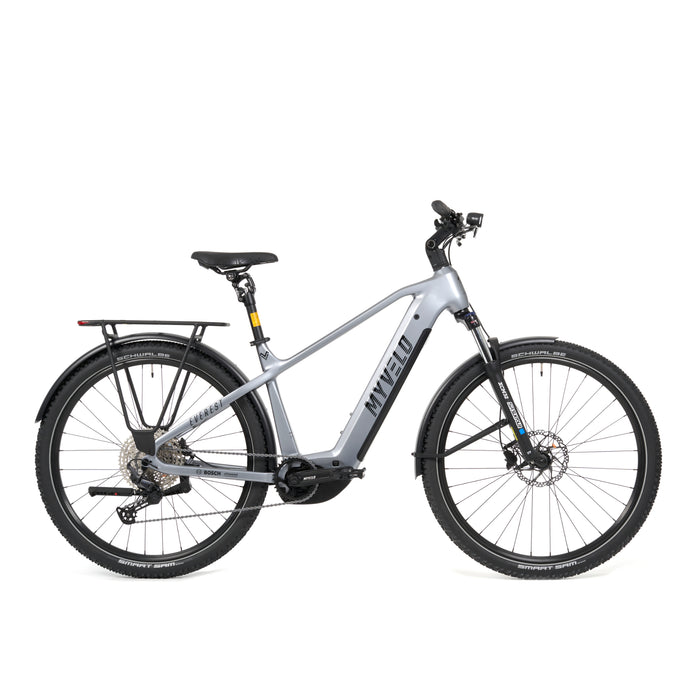
SUV e-bikes or trekking e-bikes are particularly well-suited for commuters, as they combine everyday life, leisure and longer tours.
Conclusion: High petrol prices are making e-bikes increasingly attractive.
Rising petrol prices are causing many people to rethink their mobility habits. The e-bike offers a compelling alternative to the car – especially for short and medium distances.
The advantages are clear:
Those who regularly travel by e-bike instead of by car not only save money, but also gain time, health and quality of life .
Especially in times of high petrol prices, it becomes clear: 🚴 The e-bike is not just a leisure device – but a real mobility solution for everyday life.