The Problem with the Dead Spot
This exact moment is the so-called dead spot – and it is the most demanding phase of e-bike riding.
Why? Because everything comes together at once:
Starting on a hill is therefore the supreme discipline – for you and the motor. And this is exactly where it becomes clear why the often advertised "250 watts" on the motor is only half the truth.
The MYVELO Power Calculator
How much power do you really need to start on a hill?
👉 Find out for yourself with the MYVELO Power Calculator
🤓 For Tech Nerds: The Physics Behind the Calculation
Behind our calculator is no magic, but solid physics. If you want to understand why e-bikes need so much power on a hill, you need to know three factors that work against you:
1. Lifting Power (The Fight Against Gravity)
This is the most important part. As soon as you go uphill, you have to lift your entire weight (rider, bike, and luggage) a little bit with every meter.
2. Acceleration Power (Overcoming Inertia)
A body at rest wants to remain at rest – that is the law of inertia. To go from a standstill to about 5 km/h, a short, powerful impulse is needed.
3. Rolling Resistance and Mechanics (The "Loss")
No bicycle runs perfectly frictionless. The tires flex on the asphalt, and the chain and gears in the motor generate a small amount of heat.
In summary: The required wattage is the sum of lifting + pushing + friction loss. This also explains why the power increases so dramatically if you add just a few more kilos or the incline increases by just 2%.
Myth 250 Watts: Continuous Power vs. Peak Power
Many e-bike riders believe: "My motor has 250 watts – that's not much."
That's true – but also not.
The Legal Situation
The 250 watts are the so-called rated continuous power.
It is legally stipulated so that an e-bike is considered a bicycle and can be ridden without a driver's license.
The Reality
Modern e-bike motors are significantly more powerful than they appear on paper.
Why This Is Crucial
Imagine:
With a true 250 watts, starting would be physically almost impossible. The motor therefore uses significantly more power for a short time to get you over the critical point.
👉 This means: It's not the continuous power that decides when starting – but the peak power.
Your Best Friend on the Hill: The Walk Assist
Many underestimate it – yet it is invaluable, especially on a hill: the walk assist.
Function
More Than Just Pushing
What many don't know: The walk assist can also help when setting off, not just when pushing.
Especially with:
-
heavy cargo bikes
-
steep climbs
-
unstable footing
...it gives you that crucial initial impulse.
Advantage for Your Joints
The first pedal stroke is the most strenuous for the knees. With walk assist, you noticeably reduce this strain.
👉 Pro tip: Consciously use the walk assist when starting on a hill – your body will thank you.
The Physics of Efficiency: Gear Selection and Cadence
The most common mistake when starting?
👉 Starting in the wrong gear.
Think of a Car
You wouldn't start a car on a hill in 5th gear, would you? But this often happens with e-bikes.
The Consequences of Too High a Gear
-
❌ Motor works inefficiently
-
❌ High heat generation (overheating risk)
-
❌ Extremely high battery consumption
-
❌ Sluggish, heavy riding feel
Why This Is So
E-bike motors work most efficiently at:
Too high a gear forces the motor into an unfavorable speed range.
The Crucial Pro Tip
👉 Shift down BEFORE stopping.
This gives you:
-
an easier start
-
better motor assistance
-
less wear
-
more range
Conclusion & Checklist for Hill Riders
Starting on a hill is no accident – it's a combination of technique, physics, and preparation.
The Most Important Factors:
-
⚖️ Weight: The heavier, the more power needed
-
⛰️ Incline: The biggest influencing factor
-
⚙️ Gear selection: Crucial for efficiency
-
⚡ Motor power: Peak power makes the difference
-
🦵 Technique: Clean, anticipatory start
Checklist for Relaxed Hill Starts
-
✔️ Shift down in good time before stopping
-
✔️ Use walk assist if necessary
-
✔️ Start with a high cadence
-
✔️ Build up pressure steadily – don't "slam" it
-
✔️ Let the motor do the work – don't fight against it
👉 Are you planning tours with a lot of weight or steep climbs?
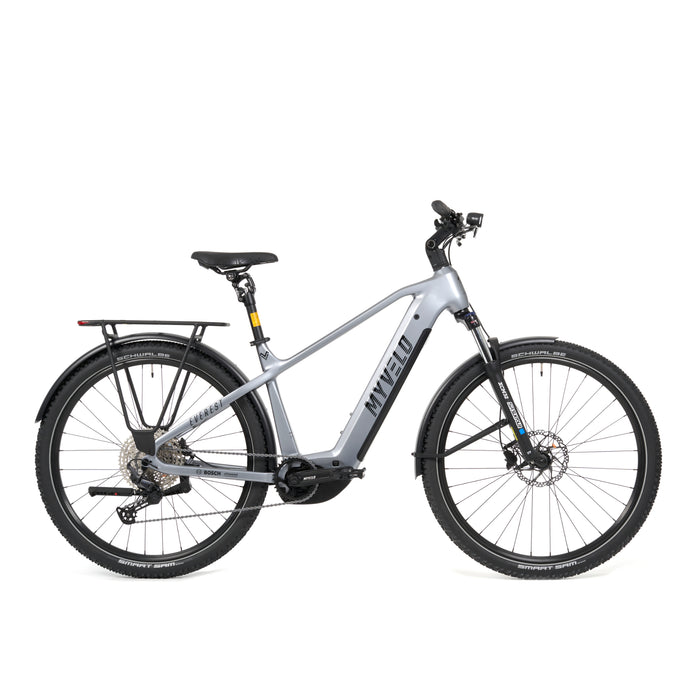
Then it's worth looking at e-bikes with particularly high torque and strong peak power – that's exactly what the MYVELO powerhouses are built for.
💬 Share Your Experience: What was the steepest ramp you've ever conquered with luggage?