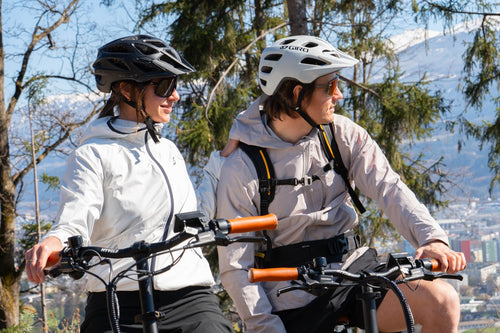
1. Classic bicycle – light, affordable, sporty
For many, the good old bicycle is still the first choice for commuting. It's uncomplicated, inexpensive, and brings exercise into everyday life – but not every route is easily manageable by bicycle.
Ideal for:
-
Short to medium distances (up to approx. 10 km)
-
Flat routes without significant inclines
-
Commuters with secure parking facilities
Advantages:
Challenges:
-
Weather dependent (rain gear necessary)
-
Strenuous without motor assistance when facing headwinds or inclines.
-
Not ideal for combining with public transport (bulky)
2. Folding bike – compact & flexible
When space is limited or the need to combine travel with public transport is a factor, the folding bike comes into play. It is arguably the most versatile solution for urban commuters who want to travel flexibly and in a space-saving manner.
Ideal for:
-
Multimodal commuting (e.g., bicycle + train)
-
People with little storage space or a small apartment
-
Short distances in the city
Advantages:
-
Easily foldable and portable for use on trains/in the office
-
No extra ticket needed on many forms of transport
-
Space-saving (also in the trunk or under the desk)
Challenges:
-
Smaller wheels = less comfort on longer journeys
-
Usually no luggage rack or suspension.
-
On inclines, the load quickly reaches its limit.
3. E-bike folding bike – the best of both worlds
The folding e-bike combines mobility and comfort: It rides effortlessly – even in windy conditions or on slight inclines – while remaining compact and foldable. A smart solution for anyone who wants more power but doesn't want to sacrifice flexibility.
Ideal for:
-
Commuting routes with slight inclines or headwinds
-
Combination with public transport, e.g. for the journey from the train station to work
-
Commuters who like a more comfortable start to the day
Advantages:
-
It assists with pedaling – you won't arrive at the office sweaty.
-
Still foldable – despite the motor and battery
-
Greater comfort compared to the classic folding bike
Challenges:
-
Increased weight due to motor and battery
-
Charging infrastructure required (ideally at home or in the office)
-
More expensive than a normal folding bike
4. SUV E-Bike – Comfort & Power for Every Commute
For those who travel long distances or not on paved bike paths, the SUV e-bike is the ideal companion. It is powerfully motorized, comfortably suspended, and reliable even in bad weather.
Ideal for:
-
Long distances (10–30 km)
-
Hilly topography, forest paths or poor cycling infrastructure
-
Year-round commuting in all weather
Advantages:
-
Powerful motor for effortless commuting, even on inclines
-
Wide tires and suspension for comfort and safety
-
Ideal for bags, laptop backpacks, etc. thanks to the luggage system.
Challenges:
5. Combination with public transport – the multimodal mix
Not everyone can or wants to cycle the entire distance – this is where buses and trains come in. Combined with a bicycle, folding bike, or e-bike, they offer a flexible and often time-saving solution for everyday life.
Many commuters combine cycling or e-biking with bus and train – for example, when the journey to work is too long for just one means of transport.
Examples of combinations:
-
Folding bike + train: Commuting by regional train and the last mile by folding bike
-
SUV, e-bike + S-Bahn: Long distance by e-bike, switch to train in bad weather
-
Bicycle + bus: Short commute to the bus stop, then continue by bus.
Tip: Many public transport companies now offer combined fares, bicycle transport options, or special bicycle compartments. It's worth checking the local regulations. Folding bikes are generally considered luggage when folded and don't incur an additional charge.
6. Alternative: Electric scooters & e-scooters – a clever solution for the city?
Especially in cities, many commuters rely on electric scooters or e-scooters . They are compact, quick to set up, and require hardly any space. But how do they compare to bicycles and e-bikes?
Ideal for:
-
Very short distances (1–5 km)
-
Last mile from the train station to work
-
People with little storage space
Advantages:
-
Extremely space-saving and lightweight
-
Quickly foldable and portable on buses and trains
-
No sweating – even without muscle power
Challenges:
-
Very limited range compared to e-bikes
-
Little comfort on uneven paths
-
Less safe in wet conditions or in winter
If you're unsure whether an e-scooter or an e-bike is a better fit for your everyday life, you can find a direct comparison of the two forms of mobility on our blog.
Range & charging infrastructure – what you should consider
Commuters want to arrive safely – whether by e-bike or SUV e-bike. The range depends heavily on the terrain, riding mode , and battery capacity. If you're unsure how far you can actually go with your e-bike, our range calculator can help.
Tip:
Charging at the employer's premises:
More and more companies are supporting sustainable mobility. Ask if you can charge your e-bike at the office – ideally via a secure power outlet in the bike room. Some employers even provide charging infrastructure or promote e-bike leasing programs.
And what about the weather?
Weather is a crucial factor, especially when commuting. E-bikes and SUV e-bikes particularly shine here, as they allow for relatively relaxed riding even in headwinds or wet conditions.
Recommendations:
-
Rain protection: Lightweight rain jacket, waterproof bicycle bags, helmet cover
-
Lighting: Always drive with clearly visible lights – especially in winter
-
Winter commuting: SUV e-bikes with knobby tires or studded tires are also suitable for snow
Conclusion: Which commuting option suits you best?
| pendulum type |
Best route |
Suitable for public transport combinations |
Weatherproof |
Price level |
| Bicycle
|
3–10 km |
Restricted |
Restricted |
💰 |
| Folding bike |
1–5 km |
✅ Optimal |
Restricted |
💰💰 |
| E-bike folding bike
|
5–15 km |
✅ Very good |
✅ Good |
💰💰💰 |
| SUV E-Bike
|
10–30 km |
❌ Less suitable |
✅ Very good |
💰💰💰💰 |
Final tip: Try out different options.
If you need help choosing the right bicycle or e-bike – we're happy to advise you in the shop or by phone. Ultimately, what matters is that your commute doesn't stress you out, but instead becomes the highlight of your day.