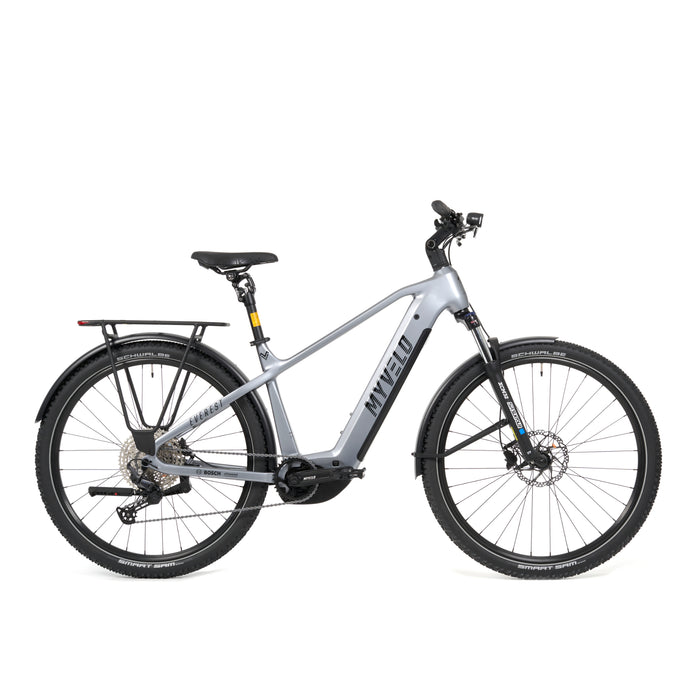
This article explains how declining balance depreciation works , who it applies to, and why buying an e-bike between 2025 and 2027 is particularly tax-efficient .
What exactly does declining-balance depreciation mean?
Depreciation (AfA – allowance for wear and tear) is the tax-deductible distribution of the acquisition costs of an asset over several years. A basic distinction is made between:
-
Straight-line depreciation : The same amount is depreciated each year.
-
Declining balance depreciation : A higher percentage is depreciated in the first few years, decreasing with each subsequent year.
Especially for capital goods like e-bikes, which are used heavily at the beginning, declining-balance depreciation is often much more sensible.
Legal basis: Section 7 Paragraph 2 of the German Income Tax Act (EStG)
The declining-balance depreciation according to § 7 para. 2 EStG was suspended in recent years, but was reintroduced by the Growth Opportunities Act .
Applicability for e-bikes
The new regulation applies to:
👉 E-bikes are considered movable assets for tax purposes if they are allocated to business assets (e.g. for delivery services, field service, commuting routes or as company bikes ).
Depreciation of e-bikes: Linear vs. declining balance
Straight-line depreciation (standard)
Example: An e-bike costs €5,000 net → approx. €715 depreciation per year.
Declining balance depreciation (new & particularly attractive)
With the reintroduction of declining-balance depreciation, the following rules apply:
-
Maximum three times the linear depreciation
-
Maximum limit: 30% per year
-
Calculation is based on the respective remaining book value
Since the linear depreciation for e-bikes is around 14.3%, the maximum rate of 30% applies directly here.
Example calculation: This is how significant the tax advantage is
Purchase price of e-bike: €5,000 (net)
Declining balance depreciation:
-
Year 1: 30% of €5,000 = €1,500
-
Year 2: 30% of €3,500 = €1,050
-
Year 3: 30% of €2,450 = €735
👉 Over €3,285 has already been written off after just three years.
For comparison:
In a linear fashion, it would only amount to around €2,145 after three years.
Conclusion: Declining-balance depreciation provides significantly higher tax relief in the first few years – ideal for liquidity and investment planning.
For whom is declining-balance depreciation particularly worthwhile?
This regulation is particularly interesting for:
-
Self-employed & freelancers
-
Companies with a vehicle fleet or company bicycles
-
Delivery services, craft businesses & service companies
-
Businesses that make intensive use of e-bikes
-
Companies with high investment needs and tax burden
Especially in economically challenging times, the higher initial depreciation can be a decisive advantage.
Switching to straight-line depreciation is possible
Another advantage: According to Section 7 Paragraph 3 of the German Income Tax Act (EStG), it is possible to switch from declining balance to straight-line depreciation at any time , as soon as the latter is more advantageous.
👉 This allows for optimal tax planning over the entire usage period of the e-bike .
Now is the perfect time for a company e-bike
The reintroduction of declining-balance depreciation makes purchasing an e-bike between 2025 and 2027 particularly attractive from a tax perspective . With up to 30% depreciation per year, investment costs can be claimed more quickly – a clear advantage over traditional straight-line depreciation.
Anyone who was already considering an e-bike for business purposes now benefits twice over:
of modern mobility and noticeable tax relief.
💡 Tip: The specific tax treatment should always be discussed with a tax advisor – especially in the case of mixed use.