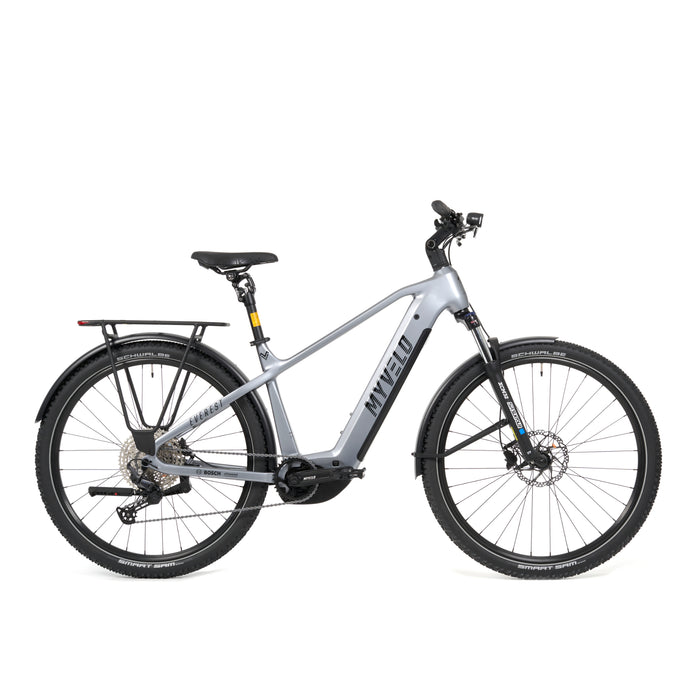
1. Why even think about a replacement?
Many people don't use their car for long distances in everyday life, but mainly for short trips:
-
Commuting to work (often less than 15 km)
-
Shopping at the supermarket or weekly market
-
Taking children to school
-
Leisure trips in the city
According to Statista (2023) , approximately 55% of all car journeys are shorter than 10 km – a distance that an e-bike can easily cover. This is precisely where the potential lies to replace the car.
Furthermore, the costs of owning a car are constantly rising: insurance, taxes, fuel, and maintenance are straining the budgets of many households. E-bikes offer an affordable alternative that is also healthy and environmentally friendly .
2. Advantages: Why the e-bike can replace the car
🌱 Sustainability
An e-bike produces almost no CO₂ emissions during operation. While an average car in Germany consumes about 4.7 liters of fuel per 100 km and produces around 11 kg of CO₂ per 100 km , an e-bike consumes an average of 1–2 kWh of electricity per 100 km , which corresponds to about 0.5 kg of CO₂ – significantly less than a car.
💸 Cost savings
According to the ADAC, the average annual cost of owning a car, including purchase, insurance, taxes, maintenance and fuel, is €6,000–€7,000 .
A high-quality e-bike costs between €2,000 and €5,000 , depending on the model. If you factor in electricity (approx. €2–5 per 100 km), maintenance (approx. €100–150 per year), and potential battery replacements, you can save several thousand euros per year in everyday use.
Example:
🚦 Time savings in the city
In urban areas, e-bikes often get you to your destination faster. Traffic jams can be avoided, bike paths offer direct routes, and there's no need to search for parking. In cities like Berlin, Hamburg, or Munich, this can easily save you 2-3 hours per week.
💪 Health
E-bikes promote exercise, cardiovascular health, and muscle building – especially in the lower body (thighs, buttocks, calves). The back also benefits from the upright posture on city or trekking bikes.
🏡 Space requirements
A car occupies around 12–15 square meters of parking space, while an e-bike can often be stored in garages, bicycle cellars, or even inside an apartment . This is a significant advantage, especially in cities with limited parking.
3. Limits and Challenges
Of course, there are situations where a car is (even) more practical:
-
Weather: Rain, snow, or extreme heat can be unpleasant, even with engine assistance. Rain jackets and weatherproof clothing help, but they don't replace a dry car.
-
Transport volume: Large pieces of furniture, bicycle accessories or DIY store purchases are difficult – unless you use e-cargo bikes .
-
Family journeys: Transporting several children at once requires special trailers or cargo bikes.
-
Long distances: Trips over 50 km each way can be tiring despite the motor and require charging breaks.
4. Practical solutions for everyday life and commuting
🚲 E-cargo bikes
E-cargo bikes are genuine car alternatives for families or those who frequently transport goods. Children, dogs, or groceries fit in easily. They are currently booming in cities like Hamburg and Cologne , and many models are available with rain covers, integrated seats, and long ranges.
🎒 Bicycle bags & trailers
Waterproof bicycle bags, baskets, or a small trailer make shopping and packages easy to transport. Even crates of drinks or small pieces of furniture can be transported conveniently this way.
🔋 Swappable batteries and charging infrastructure
A second battery in your luggage allows for longer tours without worrying about running out of power. Public charging points for e-bikes are becoming increasingly common in cities, and supermarkets and employers also offer charging options.
🧥 Clothing & Equipment
Functional clothing, a rain jacket, and a helmet ensure comfort – regardless of the weather. For commuters, a combination of weatherproof clothing and a light change of shirt for the office is often worthwhile.
5. Practical examples from Germany
-
Commuters in the city: Those who drive 10 km to work every day save around 4,000 km of car travel over 200 working days, which corresponds to about €500 in fuel costs and over 600 kg of CO₂ .
-
Families with cargo bikes: Many parents report that the e-bike is more practical for kindergarten and school trips because you can stop right in front of the door – and the children are still transported safely.
-
Rural residents: Even in rural areas, e-bikes are increasingly replacing the second car, for example for trips to the supermarket, to work in the neighboring town or for leisure activities.
6. Policy, funding and infrastructure
The government supports this trend with funding programs:
-
Company bike leasing : Employers can offer e-bikes in a tax-efficient manner – similar to a company car.
-
Expansion of cycle paths : More and more cities are investing in wider, safer cycle paths , traffic light optimization and cycle streets.
-
Charging infrastructure : Public charging stations for e-bikes are increasingly being installed, including in parking garages and at train stations.
The combination of subsidies, infrastructure and increasing acceptance makes the e-bike a realistic car replacement in many everyday scenarios.
7. Health and social effects
Those who leave their car at home in favor of an e-bike not only benefit financially:
-
Exercise in everyday life : Commuting by e-bike significantly increases daily activity, even without a gym.
-
Mental health : Cycling reduces stress , improves concentration and provides fresh air instead of car exhaust fumes.
-
Societal effect : Fewer cars mean less congestion, less noise, cleaner air and a higher quality of life in cities.
8. Tips for switching from car to e-bike
-
Test the route: Start with a route you would drive daily.
-
Proper equipment: helmet, lights, luggage system, weatherproof clothing .
-
Choose the right e-bike: city bike, trekking bike or cargo bike – depending on your needs.
-
Plan your battery life: Use a second battery or charging options at your workplace.
-
Gradually switch over: First, drive short distances with an e-bike before the car stops completely.
9. Conclusion: Flexibility instead of sacrifice
An e-bike as a car replacement is n't perfect for every situation , but it's perfectly adequate for most everyday journeys. With the right equipment, you can commute comfortably, go shopping, and even transport children.
Adjusting your mobility habits saves money, promotes a healthier lifestyle, and contributes to climate protection. E-bikes are not about sacrifice, but rather a flexible, smart alternative that simplifies life in both urban and rural areas.
👉 Perhaps it's time to leave the car at home more often – or even switch to two wheels entirely.