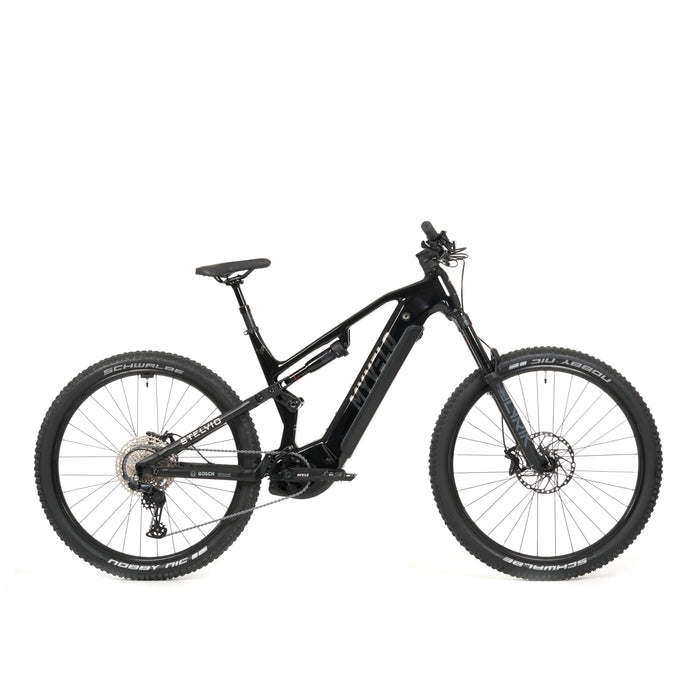
The 250 W specification is legally standardized for pedelecs – but it says little about how the motor truly feels or how powerfully it performs in crucial moments. Especially for sporty riders, mountainous routes, or heavy loads, peak power can be decisive, as it describes the motor's ability to deliver significantly more power over short periods.
What is continuous rated power?
➤ Definition: The power a motor can deliver continuously over a longer period, thermally safe and without overheating.
➤ Example: A motor with 250 W continuous rated power can maintain this power consistently for many minutes.
➡️ It is the baseline power to which legal approvals, battery range calculations, and system evaluations refer.
What is peak power?
➤ Definition: The maximum power a motor can provide for a short period – typically for seconds or a few minutes.
➤ Example: A motor with 250 W continuous rated power can achieve a peak power of 500 W or more – for instance, when starting or on steep climbs.
➡️ This power is crucial for acceleration, hill climbing performance, and riding feel.
How do peak and continuous power differ in practice?
| Characteristic |
Continuous Rated Power |
Peak Power |
| Duration |
Longer (minutes) |
Short (seconds) |
| Thermal Load |
Low |
High |
| Relevance |
Everyday use & efficiency |
Starting & steep climbs |
| Measurable by standard |
Yes |
Rarely standardized |
Why peak power isn't everything
1) Thermal Limits
Peak performance is only possible because the motor can handle more current and torque for a short time. If this power is demanded for too long, overheating is a risk.
2) Battery Limitation
High peak power heavily stresses the battery – which can lead to faster charge loss and shorter range.
3) Software Regulation
Many modern systems limit the peak phase as soon as temperature or current flow reaches a critical level.
Practical examples
👉 Flat city traffic at 25 km/h: Here, the continuous rated power primarily determines how smoothly and efficiently the system assists.
👉 Steep climb with luggage: The peak power determines whether you can accelerate powerfully enough or if the system limits early.
👉 Starting at traffic lights: A high peak value ensures more dynamic acceleration – without the need for increased continuous power.
Conclusion: Correctly classifying power specifications
✔ Continuous rated power describes the continuous power base of an e-bike motor – important for everyday use, efficiency, and range.
✔ Peak power shows how powerfully a motor can assist for a short period – important for dynamics, climbs, and acceleration.
✔ For a well-informed purchase decision, one should always consider both – and not just be dazzled by impressive peak numbers.