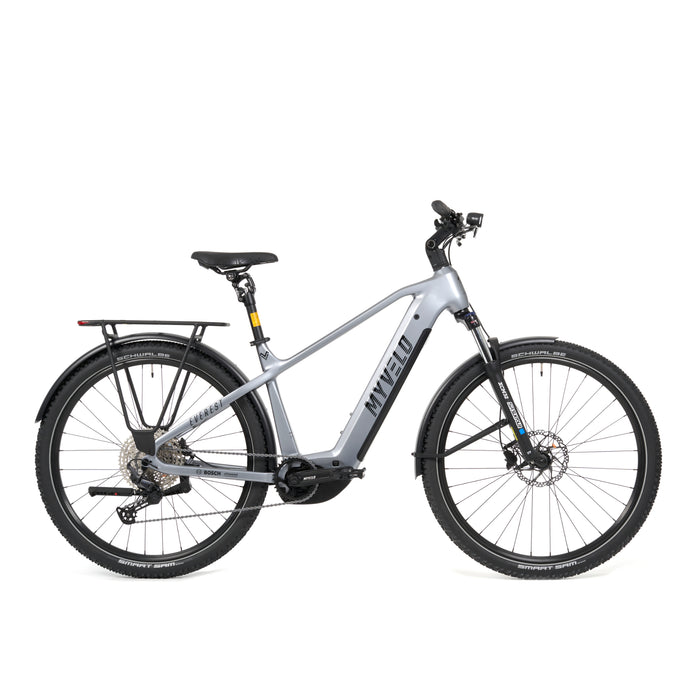
Electric bicycle or e-bike - what exactly is behind it?
The terms e-bike , pedelec, and electric bicycle are often used interchangeably, but there are subtle yet important differences. In everyday language, "electric bicycle" usually refers to a pedelec – a bicycle that only provides electric assistance while you pedal . The motor helps up to a speed of 25 km/h; beyond that, you continue riding solely with your own muscle power.
A true e-bike, on the other hand, can also be ridden without pedaling , similar to a moped. However, this type is much less common on the road and often requires registration.
For the vast majority of models on the market, the following applies: The e-bike detects how hard you are pedaling and automatically supplements your effort – completely naturally and harmoniously. But how does this work technically?
The construction of an electric bicycle - mechanics meets electronics
A modern electric bicycle consists essentially of the same components as a conventional bicycle – supplemented by an electric drive system. The most important parts are:
-
Motor : provides electric assistance
-
Battery : supplies the energy
-
Sensors : measure pedaling force, speed and pedal movement
-
Controller : controls how much power the motor delivers
-
Display / Control unit : shows information such as speed, battery level or support level
All these components work together via an internal communication system. The result: an intuitive driving experience that seamlessly combines your muscle power with electric energy.
The motor - the heart of the electric bicycle
Without a motor, there's no electric boost. The e-bike motor is the central component that amplifies your pedaling motion. It converts electrical energy from the battery into mechanical power and transfers it to the crank or wheel.
🔸 The three engine positions
-
front wheel motor
-
It sits in the hub of the front wheel.
-
Simple design, even force distribution.
-
Disadvantage: Less traction on slippery surfaces.
-
rear-wheel motor
-
Integrated directly into the rear wheel hub.
-
Provides a sporty, direct driving feel.
-
Disadvantage: Maintenance is somewhat more complex (e.g., tire changes).
-
Mid-drive motor (bottom bracket motor)
-
Most widespread today.
-
Positioned in the center of the frame – optimal weight distribution.
-
It directly supports your pedaling power via the crank.
-
Ideal for a natural driving feel, especially on inclines.
Brands like Bosch , DJI , Shimano , Yamaha , and Bafang offer various mid-drive motor systems. For example, the Bosch Performance Line CX (Gen 5) – with up to 85–100 Nm of torque – delivers dynamic support and very precise sensor control.
👉 If you would like to learn more about Bosch motors, read our article “Bosch Motor Generations at a Glance” .
The battery - the energy source of the electric bicycle
An e-bike won't work without a battery. It stores the electrical energy that powers the motor. These are usually modern lithium-ion batteries that offer an optimal balance of weight, performance, and lifespan.
🔸 Structure and capacity
-
Capacity : is specified in watt-hours (Wh) – typically 400 Wh to 750 Wh.
-
Voltage : mostly 36 V or 48 V systems.
-
Cells : several individual battery cells, usually of type 18650 or 21700.
-
BMS (Battery Management System) : protects against overcharging, deep discharging and overheating.
The higher the capacity, the greater the range – however, the weight also increases. A good average is around 500 Wh, which allows for a range of 60–120 kilometers with moderate driving.
🔸 Battery care and lifespan
To extend the lifespan of your battery:
-
Ideally, don't constantly charge it to 100% .
-
Store it at 10–20 °C and approximately 60% charge level .
-
Avoid extreme heat or frost.
-
Use only the original charger .
A modern battery typically lasts for 500–1,000 charging cycles – that is, for many years.
Sensors and control systems – the brain of the system
For the motor to know exactly when and how much assistance to provide, it needs precise measurements. This is where various sensors come into play :
🔸 The most important sensors
-
Pedal force sensor (torque sensor)
It measures how hard you pedal – the harder you pedal, the more support you get.
→ Result: A very natural driving experience.
-
Cadence sensor
It detects that you are moving the pedals – but not how hard.
→ Typical in simpler systems.
-
speed sensor
It measures how fast you are going – the motor cuts off assistance at 25 km/h.
🔸 The control center: The controller
The controller is the brain of the e-bike. It receives sensor data, calculates the appropriate motor output in real time, and ensures that the assistance engages smoothly. Factors such as cadence , gradient, and selected assistance level are taken into account.
Modern systems also communicate with the display or smartphone apps – there you can access driving data, battery level or navigation information.
The interplay – this is how the electric tailwind is created
Imagine the process like this:
-
You start kicking.
-
The pedal force sensor measures your pedaling power.
-
The controller calculates how much additional power is needed.
-
The motor implements this support in a flash.
-
The battery provides the necessary power.
-
As soon as you stop pedaling, the assistance stops immediately.
The result: A harmonious interplay between man and machine – no jerking, no lagging, simply a smooth driving experience.
Mid-drive motors in particular score points here with their fine control and intuitive power delivery – you have the feeling of pedaling harder yourself, instead of being pulled or pushed.
Support levels and riding modes
Most systems offer several support modes , which you can switch between depending on the route and energy requirements:
-
Eco : minimal support, maximum range.
-
Tour: a balanced approach to everyday life.
-
Sport: noticeably more power for inclines.
-
Turbo: full support, ideal for mountainous routes.
Modern systems like the Bosch eBike Flow Mode even automatically adjust the support to your riding style – without any manual switching.
Energy flow and efficiency
An electric bicycle uses energy very efficiently: The motor only works when you pedal, converting electrical energy directly into torque. While a car often only converts around 20% of the energy into actual motion, the overall efficiency of an e-bike is over 80% – an impressive figure for environmentally friendly mobility.
The combination of muscle power and electric assistance is therefore not only comfortable, but also energy-efficient and sustainable .
Smart technologies – the future of the electric bicycle
Electric bicycle technology is developing rapidly. New systems integrate software, sensors, and connectivity:
-
App control: Driving data, navigation and service information directly on your smartphone.
-
GPS tracking & theft protection: Real-time location tracking and locking function.
-
Over-the-air updates: Software improvements like in a car.
-
Recuperation : Energy recovery during braking (currently still rare in pedelecs).
-
Automatic transmission: The engine and transmission communicate to always select the optimal gear.
This increasingly turns the electric bicycle into an intelligent mobility system – networked, efficient and individually adaptable.
Technology that makes everyday life easier
An e-bike is far more than just a regular bicycle with a motor. It's a sophisticated interplay of mechanics, electronics, and software. Motor, battery, sensors, and controls work together perfectly to make riding easier – whether you're out for a sporty ride, commuting to work, or leisurely enjoying the scenery.
Anyone who has experienced how harmoniously a good system works understands: electric bicycles are not a fad – they are the future of environmentally friendly mobility.
👉 Discover modern electric bicycles at MYVELO now and find the model that suits your riding style.