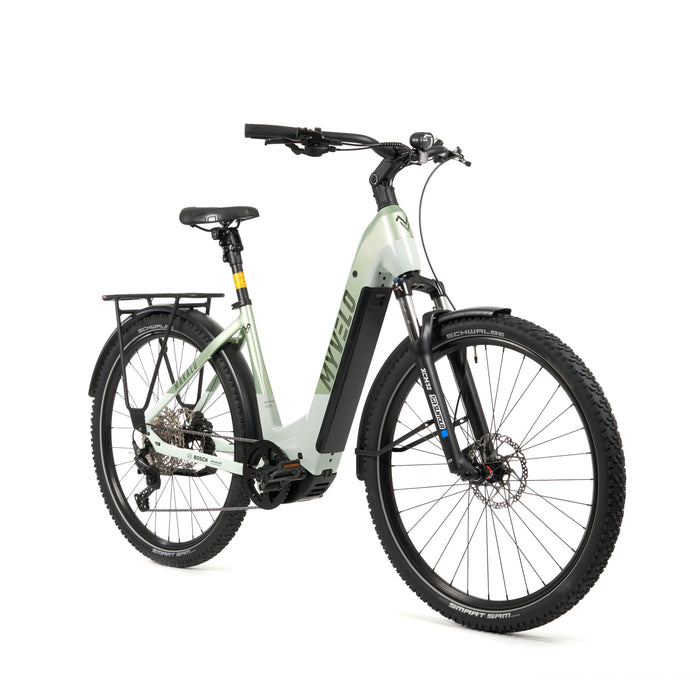
Load capacity, frame & safety explained in an easy-to-understand way
This article explains how the permissible total weight for e-bikes is defined , which components play a role, and what you should pay attention to in order to travel safely, comfortably, and for a long time .
What does "maximum permissible weight" mean for an e-bike?
The permissible total weight describes the maximum load for which an e-bike is designed. It is composed of several components:
-
Driver's body weight
-
Weight of the e-bike itself
-
Luggage, accessories, backpack or child seat
Many people only think about their own body weight – but in reality, it's the sum of everything that acts on the bike that counts.
👉 If this weight is exceeded on a permanent basis, it can cause safety risks , faster wear and tear, and even material damage.
How much weight can e-bikes typically support?
Most commercially available e-bikes are designed for a maximum permissible weight of between 120 and 130 kg . However, there are significant differences depending on the manufacturer, model, and intended use.
For many riders, the critical zone isn't when the limit is exceeded , but rather when riding constantly near the load limit . This is precisely where it's decided whether an e-bike will remain safe in the long run.
Why weight is so important for safety and handling
A higher overall weight affects several safety-relevant factors:
🚴 Driving stability
The higher the load, the greater the stress on the frame, fork, and wheels. A bike not designed for such stress can feel spongy – especially in corners or at higher speeds.
🛑 Braking performance
More weight means longer braking distances. High-quality, powerful brakes are therefore essential when the permissible total weight is fully utilized.
🔩 Material wear
Tires, spokes, bottom bracket and seatpost wear out significantly faster under high load – especially if they are not reinforced .
Which components determine the load-bearing capacity of an e-bike?
🔧 The frame – the heart of its resilience
The frame is the load-bearing element of the entire bike. For higher loads, the following are particularly important:
A stable frame not only ensures safety, but also a smooth, controlled driving experience.
🚲 Wheels & Tires
An often underestimated point. Especially with higher weight, the following are crucial:
They distribute the weight better and provide more comfort and puncture resistance.
🛑 Brakes & Suspension
With a higher overall weight, brakes must react reliably and powerfully. Hydraulic disc brakes are clearly preferable here. A high-quality suspension fork can also help to absorb peak loads.
What happens if you exceed the maximum weight?
Nothing usually happens in the short term – but in the long run, it certainly does . Possible consequences:
That's precisely why it's worth choosing an e-bike from the outset that is not ridden at its limit , but with a reserve .
For whom are particularly stable e-bikes a good idea?
A particularly robust e-bike is recommended if:
-
the body weight is close to the maximum load capacity
-
luggage is regularly transported
-
longer distances or inclines are driven
-
Safety and comfort are the focus
👉 In these cases, it is worth taking a look at specially designed e-bikes for higher loads , which optimally coordinate the frame, components and handling.
Conclusion: Weight is not an obstacle – the right e-bike is crucial.
E-bikes are generally very robust , but not every model is suitable for every body weight. Crucial factors are not only the motor power, but above all:
Those who take these points into account can enjoy riding an e-bike safely, comfortably and for a long time – regardless of their own weight.